IUPAC Naming quiz #5 Flashcards

IUPAC Naming quiz #5
Control buttons has been changed to "navigation" mode.
1/10
  • How do you name a compound with a condensed formula such as CH3CH2CH2CH2CH2COOH?
    The compound is named as hexanoic acid, with the carboxylic acid group at position 1 on a six-carbon chain.
  • How do you name a compound with a condensed formula such as CH3CH2CH2CH2CH2COOCH3?
    The compound is named as methyl hexanoate, with the methyl group attached to the carboxylate oxygen of hexanoic acid.
  • How do you name a compound with a condensed formula such as CH3CH2CH2CH2CH2CHO?
    The compound is named as hexanal, with the aldehyde group at position 1 on a six-carbon chain.
  • How do you name a compound with a condensed formula such as CH3CH2CH2CH2CH2COCH3?
    The compound is named as 2-heptanone, with the ketone group at position 2 on a seven-carbon chain.
  • What is the main purpose of the IUPAC nomenclature system established in 1919?
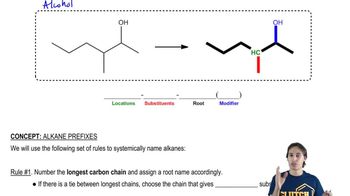
    The IUPAC system was created to provide a systematic and uniform way to name organic molecules, replacing inconsistent and confusing common names. This allows chemists worldwide to communicate molecular structures clearly and unambiguously.
  • How do you determine which chain to select as the parent chain when there are two chains of equal length?
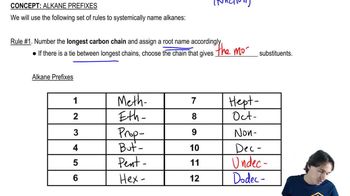
    You select the chain that results in the greatest number of substituents. This approach typically leads to smaller, easier-to-name substituents.
  • What rule is followed when numbering the parent chain to assign locants to substituents?
    Number the chain from the end closest to the first substituent to ensure the lowest possible locants for all substituents. If there is a tie, compare the next substituent or use alphabetical order as a tiebreaker.
  • How are multiple identical substituents indicated in IUPAC names?
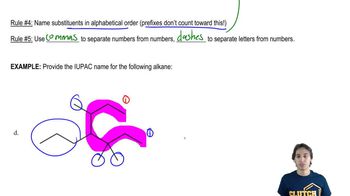
    Prefixes such as di-, tri-, and tetra- are used to indicate two, three, or four identical substituents, respectively. These prefixes are not considered when determining alphabetical order.
  • What is the difference between an alkane and an alkyl group in terms of molecular formula and naming?
    An alkyl group is derived from an alkane by removing one hydrogen atom, resulting in a branch that ends with the suffix '-yl' instead of '-ane.' For example, ethane (C2H6) becomes ethyl (C2H5) as a substituent.
  • What punctuation rules must be followed when writing IUPAC names for alkanes?
    Commas are used to separate numbers from other numbers, and hyphens are used to separate numbers from letters. No spaces should be included in the final name.