Skip to main content
Organic Chemistry
My Course
Learn
Exam Prep
AI Tutor
Study Guides
Textbook Solutions
Flashcards
Explore
Try the app
My Course
Learn
Exam Prep
AI Tutor
Study Guides
Textbook Solutions
Flashcards
Explore
Try the app
Back
Kolbe-Schmidt Reaction definitions
You can tap to flip the card.
Kolbe-Schmidt Reaction
You can tap to flip the card.
👆
Kolbe-Schmidt Reaction
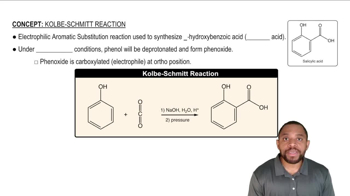
A process converting phenol to salicylic acid via carboxylation at the ortho position under basic, high-pressure conditions.
Track progress
Control buttons has been changed to "navigation" mode.
1/15
Related flashcards
Related practice
Recommended videos
Kolbe-Schmidt Reaction quiz
Kolbe-Schmidt Reaction
15 Terms
Kolbe-Schmidt Reaction
20. Phenols
5 problems
Topic
Cleavage of Phenyl Ethers
20. Phenols
5 problems
Topic
25. Phenols
4 topics
12 problems
Chapter
Johnny
Guided course
2:08
Kolbe-Schmidt Reaction Concept 1
799
views
Guided course
4:57
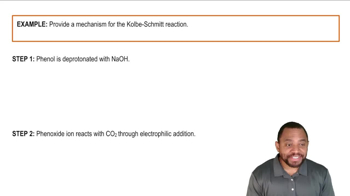
Kolbe-Schmidt Reaction Example 1
655
views
Terms in this set (15)
Hide definitions
Kolbe-Schmidt Reaction
A process converting phenol to salicylic acid via carboxylation at the ortho position under basic, high-pressure conditions.
Electrophilic Aromatic Substitution
A reaction where an aromatic ring's hydrogen is replaced by an electrophile, maintaining aromaticity.
Salicylic Acid
A compound with both hydroxyl and carboxyl groups on a benzene ring, stabilized by intramolecular hydrogen bonding.
Phenol
An aromatic compound with a hydroxyl group directly attached to a benzene ring, serving as the starting material.
Phenoxide
The conjugate base formed when phenol loses a proton under basic conditions, increasing nucleophilicity.
Carboxylation
The introduction of a carboxyl group onto an aromatic ring, typically using carbon dioxide as the source.
Ortho Position
A location on a benzene ring adjacent to a substituent, favored in this reaction due to hydrogen bonding.
Intramolecular Hydrogen Bonding
A stabilizing interaction between a hydrogen and an electronegative atom within the same molecule.
Carbon Dioxide
A reagent acting as the carboxyl group source in the transformation of phenoxide to salicylic acid.
Sodium Hydroxide
A strong base used to deprotonate phenol, generating the reactive phenoxide ion.
Benzene Ring
A six-membered aromatic structure serving as the core framework for substitution reactions.
Hydroxyl Group
A functional group consisting of an oxygen and hydrogen, influencing reactivity and directing effects on benzene.
Carboxylic Acid
A functional group characterized by a carbonyl and hydroxyl on the same carbon, formed at the ortho position.
Ortho-Para Director
A substituent that increases the likelihood of new groups attaching to the ortho or para positions on a benzene ring.
Steric Hindrance
A phenomenon where bulky groups on a molecule prevent reactions at certain positions due to spatial constraints.
 BackBack
 2:08
2:08