Organic Chemistry
My Course
Learn
Exam Prep
AI Tutor
Study Guides
Textbook Solutions
Flashcards
Explore
Try the app
My Course
Learn
Exam Prep
AI Tutor
Study Guides
Textbook Solutions
Flashcards
Explore
Try the app
Back
Kumada Coupling Reaction quiz
You can tap to flip the card.
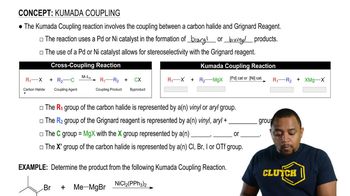
What two types of catalysts are commonly used in the Kumada coupling reaction?
You can tap to flip the card.
👆
What two types of catalysts are commonly used in the Kumada coupling reaction?
Palladium and nickel catalysts are commonly used in the Kumada coupling reaction.
Track progress
Control buttons has been changed to "navigation" mode.
1/15
Related flashcards
Related practice
Recommended videos
Kumada Coupling Reaction definitions
Kumada Coupling Reaction
15 Terms
Negishi Coupling Reaction
35. Transition Metals
3 problems
Topic

Laura
27. Transition Metals
6 topics
14 problems
Chapter
Johnny
Guided course
03:20
Kumada Coupling Reaction
482
views
Guided course
01:20
Kumada Coupling Reaction Example 1
506
views
Guided course
03:51
Kumada Coupling Reaction
653
views
1
rank
Terms in this set (15)
Hide definitions
What two types of catalysts are commonly used in the Kumada coupling reaction?
Palladium and nickel catalysts are commonly used in the Kumada coupling reaction.
What is the main purpose of the Kumada coupling reaction?
The main purpose is to couple a carbon halide with a Grignard reagent to form biaryl or vinyl products.
What are the typical byproducts of the Kumada coupling reaction?
The typical byproducts are halides and magnesium halides, which are discarded.
What is lost from the reactants during the Kumada coupling reaction?
The halide (X) from the carbon halide and the magnesium halide (MgX) from the Grignard reagent are lost.
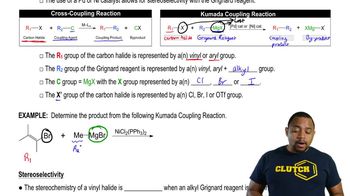
What types of groups can the R1 group of the carbon halide be in the Kumada coupling reaction?
R1 can be a vinyl or aryl group in the Kumada coupling reaction.
What types of groups can the R2 group of the Grignard reagent be in the Kumada coupling reaction?
R2 can be a vinyl, aryl, or alkyl group in the Kumada coupling reaction.
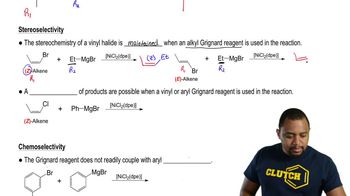
How does the Kumada coupling reaction affect the stereochemistry of a vinyl halide when an alkyl Grignard reagent is used?
The stereochemistry (E or Z configuration) of the vinyl halide is maintained when an alkyl Grignard reagent is used.
What happens to the stereochemistry when a vinyl or aryl Grignard reagent is used with a vinyl halide?
A mixture of products is formed, and the stereochemistry may change from Z to E or vice versa.
What is chemo selectivity in the context of the Kumada coupling reaction?
Chemo selectivity refers to the Grignard reagent's preference for reacting with certain halides, such as bromine, over others like chlorine.
Why does the Grignard reagent not readily couple with aryl chlorides in the Kumada reaction?
Aryl chlorides are less reactive, so the Grignard reagent prefers to react with other halides like bromine on the same aromatic ring.
What is the generic form of a cross-coupling reaction as described in the Kumada coupling context?
It involves a carbon halide (R1X) and a coupling agent (R2MgX) reacting with a transition metal catalyst to form a new bond between R1 and R2.
What role does the transition metal catalyst play in the Kumada coupling reaction?
The transition metal catalyst enables the coupling and allows for control over the stereochemistry of the product.
What happens to the halogen (such as Br or Cl) on the carbon halide during the Kumada coupling reaction?
The halogen is replaced by the R2 group from the Grignard reagent, forming the coupled product.
What is the effect of using an alkyl Grignard reagent with a vinyl halide in terms of product configuration?
The original E or Z configuration of the vinyl halide is preserved in the product.
What should be considered to predict the final product in a Kumada coupling reaction?
Both stereo selectivity and chemo selectivity must be considered to predict the final coupling product.