Back

Leaving Group Conversions - Using HX definitions

Control buttons has been changed to "navigation" mode.
1/15
  • Alcohol

    A functional group with a hydroxyl attached to carbon; poor at departing in reactions due to unstable hydroxide ion formation.
  • Leaving Group

    An atom or group that departs with an electron pair during a reaction, ideally forming a stable species after departure.
  • Alkyl Halide

    A compound where a halogen replaces a hydroxyl group, resulting in a more reactive and versatile molecule for synthesis.
  • Hydroxide Ion

    A strongly basic, unstable species formed when an alcohol departs, making it a poor candidate for substitution reactions.
  • Halide Ion

    A negatively charged halogen, such as bromide or iodide, known for its stability and effectiveness as a leaving group.
  • SN1 Mechanism

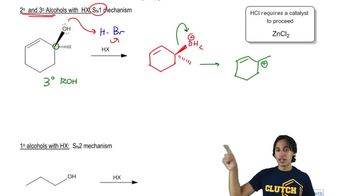
    A two-step substitution process involving carbocation formation, common with secondary and tertiary alcohols.
  • SN2 Mechanism

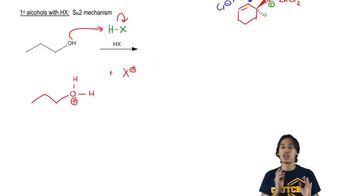
    A one-step substitution involving a backside attack, typical for primary alcohols, leading to direct displacement.
  • Carbocation

    A positively charged carbon intermediate, stabilized by alkyl groups, crucial in certain substitution reactions.
  • Lucas Reagent

    A mixture of hydrochloric acid and zinc chloride, used to enhance the conversion of alcohols to alkyl chlorides.
  • Sulfonate Ester

    A derivative of alcohols that serves as an excellent leaving group, facilitating further substitution reactions.
  • Lewis Acid

    A species that accepts an electron pair, such as zinc chloride, aiding in the activation of alcohols for substitution.
  • Protonation

    The addition of a hydrogen ion to a molecule, often making a group more likely to leave during a reaction.
  • Electronegativity

    A property of atoms like halogens, allowing them to stabilize negative charge and act as effective leaving groups.
  • Enantiomer

    One of two stereoisomers produced when a reaction can occur from either side of a planar intermediate.
  • Backside Attack

    A hallmark of SN2 reactions, where the nucleophile approaches from the side opposite the leaving group.