Back

Leaving Group Conversions - Using HX quiz

Control buttons has been changed to "navigation" mode.
1/15
  • Why are alcohols considered poor leaving groups in organic reactions?

    Alcohols are poor leaving groups because when they leave, they form a hydroxide ion (OH-), which is very unstable and a strong base.
  • What is the main strategy to convert an alcohol into a better leaving group?

    The main strategy is to convert the alcohol into an alkyl halide or a sulfonate ester, both of which are much better leaving groups.
  • What is the general formula for an alkyl halide?

    The general formula for an alkyl halide is RX, where R is an alkyl group and X is a halogen such as Cl, Br, or I.
  • Which halogens are commonly used in the conversion of alcohols to alkyl halides using HX?

    Iodine (I) and bromine (Br) are commonly used because their halide ions are stable leaving groups.
  • Why is HF not used to convert alcohols to alkyl halides?

    HF is not used because it is too weak an acid to effectively convert alcohols to alkyl halides.
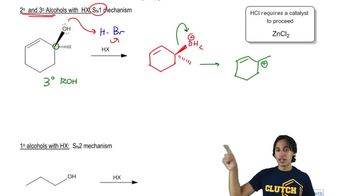
  • What mechanism do secondary and tertiary alcohols follow when reacting with HX?

    Secondary and tertiary alcohols react via the SN1 mechanism, which involves carbocation formation.
  • Why do secondary and tertiary alcohols undergo the SN1 mechanism with HX?

    They undergo SN1 because they can form relatively stable carbocations after the leaving group departs.
  • What is the first step in converting an alcohol to an alkyl halide using HX?

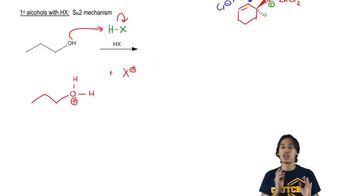
    The first step is protonation of the alcohol by HX, turning the OH group into a better leaving group (water).
  • What is the Lucas reagent and when is it used?

    The Lucas reagent is a mixture of HCl and ZnCl2, used to enhance the conversion of alcohols to alkyl chlorides.
  • How does the Lucas reagent improve the leaving group ability of alcohols?

    ZnCl2 acts as a Lewis acid, coordinating with the alcohol's oxygen and making the leaving group even better than water.
  • What mechanism do primary alcohols follow when reacting with HX?

    Primary alcohols react via the SN2 mechanism, involving a backside attack by the halide ion.
  • Why do primary alcohols not undergo the SN1 mechanism?

    Primary alcohols do not form stable carbocations, so they cannot proceed via the SN1 mechanism.
  • What is the outcome of converting an alcohol to an alkyl halide in terms of reactivity?

    The alcohol becomes much more functional and reactive, allowing for further chemical transformations.
  • What happens to stereochemistry in the SN1 conversion of alcohols to alkyl halides?

    The product is a racemic mixture because the nucleophile can attack from either side of the planar carbocation.
  • What is the key difference in the mechanism between primary and tertiary alcohols when converting to alkyl halides?

    Primary alcohols use the SN2 mechanism (one-step backside attack), while tertiary alcohols use the SN1 mechanism (carbocation intermediate).