Back

Leaving Groups definitions

Control buttons has been changed to "navigation" mode.
1/14
  • Alkyl Halide

    A molecule where a halogen atom is bonded to an alkyl group, commonly serving as a leaving group in organic reactions.
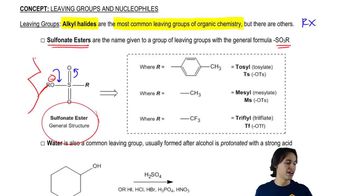
  • Sulfonate Ester

    A compound with the general formula SO3R, notable for stabilizing negative charge via resonance, making it an excellent leaving group.
  • Tosylate

    A sulfonate ester where the R group is a benzene ring with a methyl group, often abbreviated as Ts in reaction mechanisms.
  • Mesylate

    A sulfonate ester with a methyl group as the R group, abbreviated as Ms, recognized for its strong leaving group ability.
  • Triflate

    A sulfonate ester where the R group is a trifluoromethyl group, abbreviated as Tf, known for exceptional leaving group properties.
  • Resonance

    A phenomenon where electron density is delocalized across multiple atoms, stabilizing negative charge in leaving groups.
  • Protonation

    The process of adding a proton to a molecule, often converting a poor leaving group into a much better one.
  • Alcohol

    An organic compound containing a hydroxyl group, which can become a good leaving group after protonation.
  • Water

    A neutral molecule that acts as a stable leaving group after formation by protonation of an alcohol.
  • Strong Acid

    A substance capable of donating protons readily, used to convert alcohols into better leaving groups.
  • Carbocation

    A positively charged carbon species formed after a leaving group departs, often seen in SN1 and E1 mechanisms.
  • Conjugate Base

    The species formed after a leaving group departs, whose stability often determines leaving group quality.
  • Anion

    A negatively charged ion, often resulting from the departure of a leaving group in organic reactions.
  • Electronegativity

    A measure of an atom's ability to attract electrons, influencing the effectiveness of leaving groups.