Organic Chemistry
My Course
Learn
Exam Prep
AI Tutor
Study Guides
Textbook Solutions
Flashcards
Explore
Try the app
My Course
Learn
Exam Prep
AI Tutor
Study Guides
Textbook Solutions
Flashcards
Explore
Try the app
Back
Leaving Groups quiz
You can tap to flip the card.
What is the most common type of leaving group in organic chemistry?
You can tap to flip the card.
👆
What is the most common type of leaving group in organic chemistry?
Alkyl halides are the most common leaving groups in organic chemistry.
Track progress
Control buttons has been changed to "navigation" mode.
1/15
Related flashcards
Related practice
Recommended videos
Leaving Groups definitions
Leaving Groups
14 Terms
Nucleophiles and Basicity
8. Elimination Reactions
6 problems
Topic

Johnny
8. Elimination Reactions - Part 1 of 2
5 topics
11 problems
Chapter
Johnny
8. Elimination Reactions - Part 2 of 2
4 topics
10 problems
Chapter
Ernest
Guided course
07:22
The 3 important leaving groups to know.
3138
views
48
rank
17
comments
Terms in this set (15)
Hide definitions
What is the most common type of leaving group in organic chemistry?
Alkyl halides are the most common leaving groups in organic chemistry.
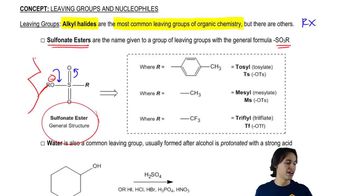
What is the general formula for a sulfonate ester?
The general formula for a sulfonate ester is SO3R.
Why are sulfonate esters considered excellent leaving groups?
Sulfonate esters are excellent leaving groups because they can stabilize negative charges through resonance.
Name the three unique types of sulfonate esters.
The three unique types of sulfonate esters are tosylates, mesylates, and triflates.
How do tosylates, mesylates, and triflates differ from each other?
They differ in the identity of the R group attached to the sulfur atom.
What abbreviation is commonly used for a mesylate group?
The abbreviation for a mesylate group is MS.
What is the abbreviation for a tosylate group?
The abbreviation for a tosylate group is TS.
How can water be converted into a good leaving group?
Water can be converted into a good leaving group by protonating an alcohol with a strong acid.
Why is alcohol (OH-) a poor leaving group?
Alcohol is a poor leaving group because OH- is very unstable and a strong base.
What happens to an alcohol after it is protonated by a strong acid?
After protonation, the alcohol becomes H2O+, which can leave as neutral water, a stable leaving group.
In reaction mechanisms, how should you treat sulfonate esters compared to alkyl halides?
You should treat sulfonate esters the same way as alkyl halides in reaction mechanisms.
What is the main purpose of a leaving group in a reaction mechanism?
The main purpose of a leaving group is to depart from the molecule, allowing the reaction to proceed.
What does the suffix '-ate' indicate in the names of sulfonate esters?
The suffix '-ate' indicates the presence of a negative charge, making it an anion.
What are the three main categories of leaving groups you should recognize?
The three main categories are alkyl halides, sulfonate esters, and water (in its protonated form).
Why is it important to recognize abbreviations like OTs or OMS in reaction mechanisms?
Recognizing these abbreviations helps you identify sulfonate esters, which are excellent leaving groups.