Back

Making Ethers - Alkoxymercuration quiz

Control buttons has been changed to "navigation" mode.
1/15
  • What is the main difference between alkoxymercuration and oxymercuration reactions?

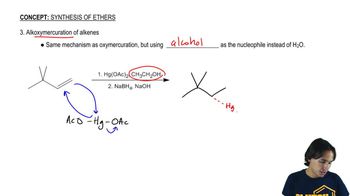
    Alkoxymercuration uses alcohol as the nucleophile instead of water, resulting in the formation of an ether instead of an alcohol.
  • What type of product is formed when alcohol is used as the nucleophile in alkoxymercuration?

    An ether is formed when alcohol is used as the nucleophile.
  • What is the role of NaBH4 in the alkoxymercuration reaction?

    NaBH4 is used in the reduction step to replace mercury with hydrogen and deprotonate the oxygen, finalizing the ether product.
  • During alkoxymercuration, which site does the alcohol attack: Markovnikov or anti-Markovnikov?

    The alcohol attacks the Markovnikov site, which has the most positive character.
  • What intermediate is formed after the double bond attacks mercury in alkoxymercuration?

    A bridged mercurinium ion intermediate is formed, with a partial bond to mercury and a positive charge.
  • Why are carbocation shifts not observed in alkoxymercuration?

    Carbocation shifts do not occur because the intermediate is a bridged ion, not a true carbocation.
  • What is the general structure of the ether product formed in alkoxymercuration?

    The general structure is R-O-R, where R represents alkyl groups from the starting materials.
  • What happens to the mercury atom during the reduction step of alkoxymercuration?

    The mercury atom is reduced to a hydrogen atom and removed from the molecule.
  • What determines whether the product of the reaction is an alcohol or an ether?

    The nucleophile used—water yields an alcohol, while alcohol yields an ether.
  • What is the purpose of the OAc group in the alkoxymercuration reaction?

    The OAc group (acetate) is part of the mercury reagent and is displaced during the formation of the bridged intermediate.
  • In the mechanism, what does the double bond attack first?

    The double bond first attacks the mercury atom, initiating the reaction.
  • What is expelled when the alcohol attacks the Markovnikov site in alkoxymercuration?

    The mercury group is expelled from the intermediate.
  • Why is it important to distinguish between water and alcohol as the nucleophile in these reactions?

    Because the choice of nucleophile determines whether the product is an alcohol or an ether.
  • Is the mechanism for alkoxymercuration fundamentally different from oxymercuration?

    No, the mechanism is the same except for the nucleophile used.
  • What is the final step in the alkoxymercuration mechanism?

    The final step is reduction with NaBH4 and OH-, which removes mercury and forms the ether.