Back

Mass Spect:Fragmentation definitions

Control buttons has been changed to "navigation" mode.
1/15
  • Ionization Potential

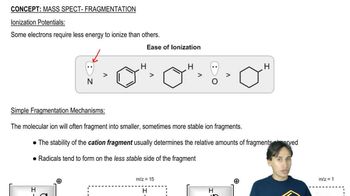
    Relative ease with which an electron is removed from a molecule by an electron beam, influencing which fragments form.
  • Radical Cation

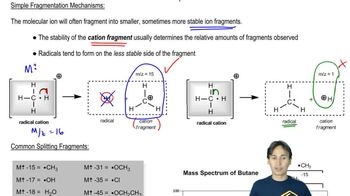
    Species formed when a molecule loses an electron, carrying both a positive charge and an unpaired electron.
  • Base Peak

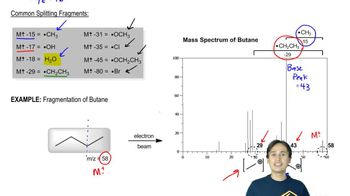
    Tallest peak in a mass spectrum, representing the most abundant ion, often a stable fragment rather than the molecular ion.
  • Molecular Ion

    Ion formed by removal of one electron from a molecule, typically corresponding to the molecule's full mass.
  • Fragmentation

    Process where radical cations break into smaller, more stable ions, generating characteristic peaks in a mass spectrum.
  • Carbocation Stability

    Tendency of a positively charged carbon to persist, influencing which fragments are most abundant in mass spectra.
  • Methyl Group Loss

    Common fragmentation resulting in a peak 15 units less than the molecular ion, due to removal of a CH3 group.
  • Ethyl Group Loss

    Fragmentation pattern producing a peak 29 units less than the molecular ion, from loss of a C2H5 group.
  • Water Loss

    Fragmentation event where H2O is eliminated, often from alcohols, resulting in a peak 18 units less than the molecular ion.
  • Vinyl Position

    Location directly attached to a double bond, which is relatively easy to ionize during mass spectrometry.
  • Aromatic Ring

    Stable cyclic structure, such as benzene, where ionization typically occurs at substituents rather than within the ring.
  • Alkane

    Hydrocarbon with only single bonds, generally showing the highest resistance to ionization in mass spectrometry.
  • Methoxy Group Loss

    Fragmentation involving removal of an OCH3 group, leading to a characteristic peak in the mass spectrum.
  • m/z Ratio

    Value representing the mass-to-charge ratio of detected ions, used to identify fragments in a mass spectrum.
  • Relative Abundance

    Proportion of a specific ion detected in a mass spectrum, reflecting the stability and likelihood of its formation.