Back

Mass Spect:Fragmentation quiz

Control buttons has been changed to "navigation" mode.
1/15
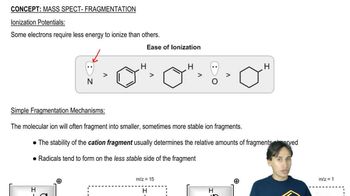
  • What does ionization potential indicate in mass spectrometry?

    Ionization potential indicates how easily an electron can be removed from a molecule by an electron beam. Lower ionization potential means the electron is more easily removed.
  • Which type of electron is the easiest to ionize in mass spectrometry?

    The lone pair on a nitrogen atom is the easiest to ionize due to its loose hold on electrons.
  • Why are single bonds in alkanes the hardest to ionize?

    Single bonds in alkanes are hardest to ionize because there are no stabilizing factors, so it takes more energy to remove an electron.
  • What determines the relative abundance of fragments in a mass spectrum?

    The stability of the resulting cation fragment determines the relative abundance of fragments in a mass spectrum.
  • Why is only the cation fragment detected in mass spectrometry?

    Only the cation fragment is detected because mass spectrometry only detects positively charged ions.
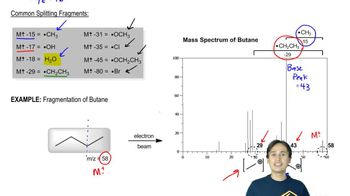
  • What is the significance of the base peak in a mass spectrum?

    The base peak is the most abundant ion detected, which often corresponds to a stable fragment rather than the molecular ion.
  • What common fragmentation pattern results in an M-15 peak?

    An M-15 peak results from the loss of a methyl group (CH3) from the molecule.
  • How is an M-18 peak formed in mass spectrometry?

    An M-18 peak is formed by the loss of a water molecule (H2O) from the compound, often via a more complex mechanism.
  • Why might both M-17 and M-18 peaks be observed when an alcohol is present?

    Both peaks can be observed because the alcohol can lose just the OH group (M-17) or lose water (M-18) by grabbing a hydrogen on its way out.
  • What does an M-29 peak typically indicate in a mass spectrum?

    An M-29 peak typically indicates the loss of an ethyl group (C2H5) from the molecule.
  • Why is the molecular ion peak often small for larger molecules?

    The molecular ion peak is often small for larger molecules because they tend to fragment more easily under the electron beam.
  • Can you always predict which fragment will be the base peak in a mass spectrum?

    No, predicting the exact size of peaks requires complex calculations and is usually determined experimentally.
  • What is the general trend for ionization potential among nitrogen, aromatics, vinyl positions, oxygen, and alkanes?

    The trend is: nitrogen lone pair < aromatics < vinyl positions < lone pairs on oxygen < single bonds in alkanes (from easiest to hardest to ionize).
  • Why is a carbocation on carbon more stable than on hydrogen in fragmentation?

    A carbocation on carbon is more stable than on hydrogen, so fragments with a carbon cation are more abundant.
  • What is a common reason for high peaks at M-43 and M-29 in butane's mass spectrum?

    High peaks at M-43 and M-29 are due to the loss of a methyl group (M-43) and an ethyl group (M-29), forming stable cation fragments.