Back

Mass Spect:Isotopes definitions

Control buttons has been changed to "navigation" mode.
1/15
  • Isotope

    Atom with identical proton count but varying neutron number, resulting in different atomic masses for the same element.
  • Mass Spectrometry

    Analytical technique that separates ions based on mass-to-charge ratio, revealing molecular structure and isotopic composition.
  • Molecular Ion

    Peak in a mass spectrum representing the intact molecule, used as a reference for comparing isotopic peaks.
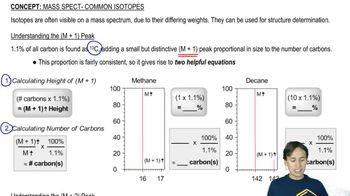
  • M+1 Peak

    Small mass spectrum peak one unit higher than the molecular ion, mainly due to carbon-13 presence in the molecule.
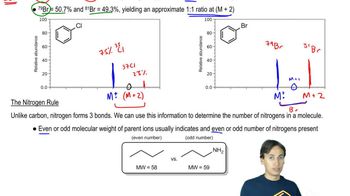
  • M+2 Peak

    Mass spectrum peak two units above the molecular ion, significant for detecting halogens like chlorine and bromine.
  • Carbon-13

    Naturally occurring carbon isotope with one extra neutron, responsible for the M+1 peak at 1.1% abundance.
  • Chlorine Isotopes

    Mixture of chlorine-35 and chlorine-37, producing a 3:1 M:M+2 peak ratio in mass spectra.
  • Bromine Isotopes

    Nearly equal amounts of bromine-79 and bromine-81, resulting in a 1:1 M:M+2 peak ratio in mass spectra.
  • Nitrogen Rule

    Guideline stating that an odd molecular weight indicates an odd number of nitrogen atoms in a molecule.
  • Base Peak

    Tallest peak in a mass spectrum, used for scaling other peak intensities, not always the molecular ion.
  • Isotopic Abundance

    Relative proportion of each isotope in nature, influencing the intensity of isotope-related peaks in mass spectra.
  • Mass-to-Charge Ratio

    Value plotted on the x-axis of a mass spectrum, determining the position of each ion peak.
  • Structure Determination

    Process of deducing molecular composition and connectivity using mass spectral data and isotopic patterns.
  • Halogen Identification

    Recognition of chlorine or bromine in a molecule by analyzing characteristic M+2 peak ratios in mass spectra.
  • Approximation Equation

    Calculation method for estimating M+1 peak height by multiplying the number of carbons by 1.1%.