Back

Michael Addition quiz

Control buttons has been changed to "navigation" mode.
1/15
  • What type of addition is the Michael reaction classified as?

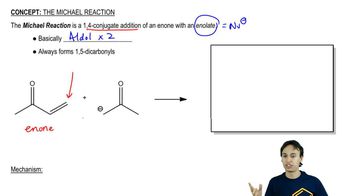
    The Michael reaction is classified as a 1,4-conjugate addition.
  • Which two types of molecules react in a Michael reaction?

    An enone and an enolate react in a Michael reaction.
  • What is the typical product formed from a Michael reaction?

    The typical product is a 1,5-dicarbonyl compound.
  • How is the Michael reaction similar to the aldol reaction?

    It is similar because the first aldol reaction creates the enone, and the Michael reaction acts like a second aldol reaction.
  • When drawing the product of a Michael reaction, what should you do with the enone's double bond?

    You should remove the double bond from the enone when drawing the product.
  • Where does the new bond form in a Michael reaction?

    The new bond forms at the conjugate (position 4) of the enone, connecting to the enolate.
  • Why should you not draw a pi bond at the new connection in the Michael product?

    Because the pi bond is lost during the reaction mechanism and does not exist in the final product.
  • What is the first mechanistic step in the Michael reaction?

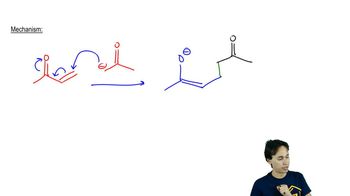
    The enolate attacks the electrophilic carbon on the enone, causing bond rearrangements.
  • What intermediate is formed immediately after the enolate attacks the enone?

    A vinyl alcohol or enol tautomer intermediate is formed.
  • What happens to the enol tautomer intermediate in a basic environment?

    It tautomerizes to the more stable keto form.
  • What is the role of protonation in the Michael reaction mechanism?

    Protonation converts the negatively charged intermediate into an enol tautomer.
  • Why is the keto form favored over the enol form after tautomerization?

    The keto form is generally more stable than the enol form unless the product is a beta dicarbonyl.
  • Does the Michael reaction mechanism apply only to enones and enolates?

    No, the mechanism applies to other types of conjugate additions as well.
  • What is the significance of resonance in the Michael reaction mechanism?

    Resonance allows the positive charge to delocalize, making the beta carbon electrophilic and susceptible to nucleophilic attack.
  • What is the main outcome of understanding the Michael reaction mechanism?

    It helps predict the formation of 1,5-dicarbonyl compounds from conjugate additions.