Back

Molecular Geometry definitions

Control buttons has been changed to "navigation" mode.
1/14
  • VSEPR Theory

    A model explaining how electron pairs around a central atom arrange themselves to minimize repulsion, determining molecular shape.
  • Hybridization

    The process where atomic orbitals blend to form new orbitals, influencing molecular geometry and bonding.
  • SP3 Hybridization

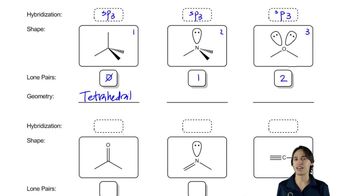
    A state where one s and three p orbitals mix, resulting in four equivalent orbitals arranged tetrahedrally.
  • SP2 Hybridization

    A state where one s and two p orbitals combine, forming three orbitals in a planar arrangement.
  • SP Hybridization

    A state where one s and one p orbital merge, creating two orbitals aligned linearly at 180 degrees.
  • Tetrahedral

    A molecular shape with four bond sites and zero lone pairs, forming a three-dimensional structure with 109.5° angles.
  • Trigonal Pyramidal

    A geometry with three atoms and one lone pair around a central atom, resembling a pyramid with a triangular base.
  • Bent

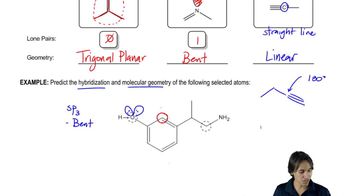
    A molecular shape where two atoms and one or two lone pairs create an angular structure, not a straight line.
  • Trigonal Planar

    A flat, triangular arrangement of three groups around a central atom, all in the same plane with 120° angles.
  • Linear

    A geometry where two groups are arranged in a straight line around a central atom, with a bond angle of 180°.
  • Bond Angle

    The angle formed between three atoms across at least two bonds, characteristic of specific molecular geometries.
  • Lone Pair

    A pair of valence electrons not involved in bonding, affecting molecular shape by occupying space around the central atom.
  • Bond Site

    A location on a central atom where either a bond or a lone pair is present, used to determine geometry.
  • Molecular Geometry

    The three-dimensional arrangement of atoms in a molecule, determined by the number of bond sites and lone pairs.