Organic Chemistry
My Course
Learn
Exam Prep
AI Tutor
Study Guides
Textbook Solutions
Flashcards
Explore
Try the app
My Course
Learn
Exam Prep
AI Tutor
Study Guides
Textbook Solutions
Flashcards
Explore
Try the app
Back
Monosaccharides - Oxidative Cleavage definitions
You can tap to flip the card.
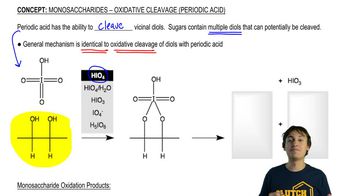
Periodic Acid
You can tap to flip the card.
👆
Periodic Acid
A reagent with multiple oxygens around iodine, used to cleave vicinal diols in sugars, forming carbonyl compounds.
Track progress
Control buttons has been changed to "navigation" mode.
1/15
Related flashcards
Related practice
Recommended videos
Monosaccharides - Oxidative Cleavage quiz
Monosaccharides - Oxidative Cleavage
10 Terms
24. Carbohydrates - Part 1 of 4
6 topics
12 problems
Chapter
Johnny
24. Carbohydrates - Part 2 of 4
5 topics
12 problems
Chapter
Johnny
24. Carbohydrates - Part 3 of 4
6 topics
12 problems
Chapter
Johnny
24. Carbohydrates - Part 4 of 4
6 topics
12 problems
Chapter
Laura
Guided course
12:17
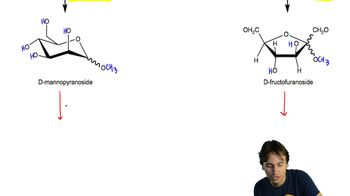
Predict the structure of the glycoside products
675
views
2
rank
1
comments
Guided course
06:41
Monosaccharides - Oxidative Cleavage
697
views
6
rank
Guided course
04:41
Monosaccharides - Oxidative Cleavage
603
views
3
rank
3
comments
Terms in this set (15)
Hide definitions
Periodic Acid
A reagent with multiple oxygens around iodine, used to cleave vicinal diols in sugars, forming carbonyl compounds.
Vicinal Diol
A pair of hydroxyl groups attached to adjacent carbons, essential for oxidative cleavage by periodic acid.
Oxidative Cleavage
A reaction where bonds between adjacent carbons are broken, converting alcohols into carbonyl-containing fragments.
Cyclic Periodic Ester
An intermediate formed when periodic acid reacts with a vicinal diol, featuring a ring structure with iodine and oxygen.
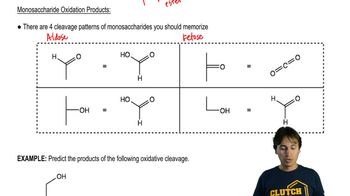
Aldose
A monosaccharide with an aldehyde group at the terminal carbon, yielding formic acid upon oxidative cleavage.
Ketose
A monosaccharide with a ketone group, typically at the second carbon, producing CO2 after oxidative cleavage.
Formic Acid
The simplest carboxylic acid, produced from the oxidative cleavage of aldehyde or internal alcohol groups in sugars.
Formaldehyde
The simplest aldehyde, generated from the oxidative cleavage of terminal alcohol groups in monosaccharides.
Periodate
An anionic form of periodic acid, IO4−, functioning identically in oxidative cleavage reactions.
Iodic Acid
A variant of periodic acid with three oxygens, acting similarly in cleaving vicinal diols.
Internal Alcohol
A hydroxyl group bonded to a carbon flanked by other carbons, yielding formic acid upon oxidative cleavage.
Terminal Alcohol
A hydroxyl group at the end of a carbon chain, producing formaldehyde when cleaved oxidatively.
Carbonyl Group
A functional group featuring a carbon double-bonded to oxygen, formed as a product in oxidative cleavage.
Sigma Bond
A single covalent bond between two carbons in a vicinal diol, broken during oxidative cleavage.
Monosaccharide
A simple sugar molecule containing multiple hydroxyl groups, susceptible to oxidative cleavage by periodic acid.