Back

Monosaccharides - Reduction (Alditols) definitions

Control buttons has been changed to "navigation" mode.
1/15
  • Monosaccharide

    A carbohydrate with a single sugar unit, containing multiple hydroxyl groups and a carbonyl group, highly reactive in redox reactions.
  • Reduction

    A chemical process converting a carbonyl group in a sugar to an alcohol, often using a hydride donor, altering functional groups but preserving stereochemistry.
  • Alditol

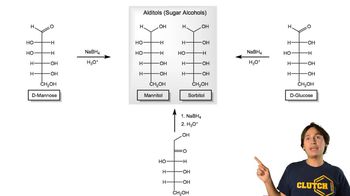
    A polyol formed by reducing a monosaccharide, lacking a carbonyl group, commonly used as a sugar substitute or food additive.
  • Sugar Alcohol

    A reduced carbohydrate with only hydroxyl groups, not classified as a true sugar or alcohol, often found in processed foods.
  • Sorbitol

    A sugar alcohol derived from glucose reduction, used as a sweetener and food thickener, with lower caloric value than sucrose.
  • Mannitol

    A sugar alcohol produced from mannose reduction, utilized in medicine as a laxative and in food as a sweetener.
  • Sodium Borohydride

    A mild reducing agent, NaBH4, commonly used to convert aldehyde groups in sugars to alcohols via nucleophilic hydride addition.
  • Hydride Donor

    A reagent that supplies a nucleophilic hydrogen atom, enabling reduction of carbonyl groups to alcohols in organic molecules.
  • Nucleophilic Addition

    A reaction mechanism where a nucleophile attacks an electrophilic carbon, such as a carbonyl, forming a new bond and intermediate.
  • Protonation

    A step following nucleophilic addition where a proton is added to an intermediate, stabilizing the newly formed alcohol group.
  • Epimer

    A stereoisomer differing in configuration at only one specific carbon atom, such as glucose and mannose at C2.
  • Ketose

    A monosaccharide containing a ketone functional group, which upon reduction can yield multiple sugar alcohol products due to racemization.
  • Racemization

    A process where a new chiral center forms with equal probability for either configuration, leading to a mixture of stereoisomers.
  • Tetrahedral Intermediate

    A transient structure formed during nucleophilic addition to a carbonyl, featuring a central carbon bonded to four substituents.
  • Chirality

    A property of a molecule having non-superimposable mirror images, crucial for the stereochemistry of sugar alcohols after reduction.