Back

Naming Anhydrides definitions

Control buttons has been changed to "navigation" mode.
1/13
  • Anhydride

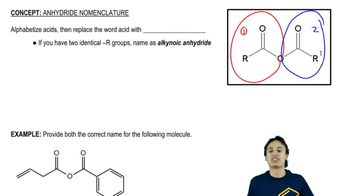
    A functional group formed by the condensation of two carboxylic acids, featuring a dicarbonyl with an oxygen atom between them.
  • Carboxylic Acid

    An organic compound containing a carbonyl and hydroxyl group on the same carbon, serving as the precursor for anhydrides.
  • Acyl Group

    A moiety derived from a carboxylic acid by removal of the hydroxyl group, present on each side of an anhydride.
  • Carbonyl

    A functional group composed of a carbon atom double-bonded to an oxygen atom, found in both carboxylic acids and anhydrides.
  • Symmetrical Anhydride

    A molecule where both R groups are identical, allowing naming based on a single carboxylic acid.
  • Alphabetical Order

    The sequence used to list the names of carboxylic acids when naming mixed anhydrides.
  • IUPAC Naming

    A systematic approach using alkanoic acid names, replacing 'acid' with 'anhydride' for these compounds.
  • Common Naming

    A traditional method using memorized names for the first five carboxylic acids when naming anhydrides.
  • Dicarbonyl

    A structural feature with two carbonyl groups separated by an oxygen atom, characteristic of anhydrides.
  • Condensation

    A reaction process where two carboxylic acids combine, releasing water, to form an anhydride.
  • R Group

    A variable side chain attached to the carbonyl in carboxylic acids and anhydrides, determining their identity.
  • Derivative

    A compound structurally related to another, such as an anhydride being related to carboxylic acids.
  • Functional Group

    A specific group of atoms within molecules responsible for characteristic chemical reactions, like the anhydride group.