Back

Naming Bicyclic Compounds definitions

Control buttons has been changed to "navigation" mode.
1/14
  • Bicyclic Compound

    A molecule featuring two or more rings fused together, often requiring special nomenclature rules.
  • Normal Bicyclic

    A structure with two rings joined by a single bond, lacking a bridge, and often denoted with a zero in naming.
  • Bridged Bicyclic

    A molecule containing three rings connected via bridgehead atoms, forming a more complex fused system.
  • Bridgehead Atom

    A carbon shared by two or more rings, always assigned the one position during nomenclature.
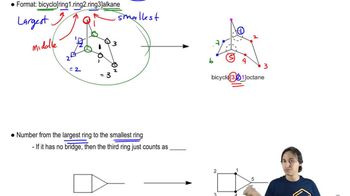
  • Bicyclo Prefix

    A naming element indicating the presence of a bicyclic structure, replacing 'cyclo' in monocyclic compounds.
  • Ring Size

    The count of non-bridgehead carbons in each ring, listed from largest to smallest in nomenclature.
  • Substituent Position

    The specific carbon number where a group is attached, determined by numbering from the largest to smallest ring.
  • Alkane Name

    The parent hydrocarbon name based on the total number of carbons in the bicyclic structure.
  • Planar Representation

    A two-dimensional drawing of a bicyclic compound, useful for visualizing ring connections.
  • Three-Dimensional Representation

    A spatial depiction of a bicyclic molecule, clarifying the arrangement of rings and bridges.
  • Non-Bridgehead Carbon

    A carbon atom within a ring that is not shared by multiple rings, crucial for determining ring sizes.
  • Numbering Sequence

    The order in which atoms are assigned numbers, starting at a bridgehead and proceeding through the largest ring.
  • Zero Bridge

    An indicator in nomenclature signifying the absence of a third ring, used in normal bicyclics.
  • Substituent

    An atom or group attached to the main bicyclic framework, its position specified in the compound's name.