Back

Naming Epoxides quiz

Control buttons has been changed to "navigation" mode.
1/15
  • What is an epoxide in terms of its structure?

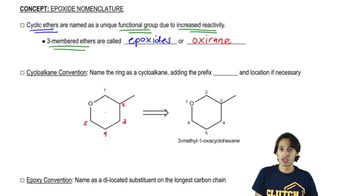
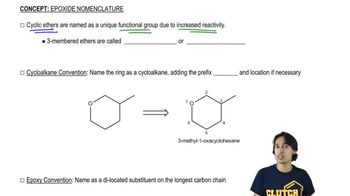
    An epoxide is a three-membered cyclic ether, also known as an oxirane, with significant ring strain.
  • Why are epoxides considered highly reactive?

    Epoxides are highly reactive due to the strain in their three-membered ring, which makes them easy to open.
  • What are the two common names for a three-membered cyclic ether?

    They are called epoxides and oxiranes; both terms refer to the same structure.
  • In the cycloalkane convention, how is the ring named when an oxygen is present?

    The ring is named as a cycloalkane with the prefix 'oxa-' to indicate the presence of an oxygen atom.
  • When numbering a ring using the cycloalkane convention, which atom gets the highest priority?

    The oxygen atom always gets the number one position due to its priority.
  • How would you name a six-membered ring with one oxygen using the cycloalkane convention?

    It would be named oxacyclohexane, indicating a six-membered ring with one oxygen atom.
  • What prefix is used if there are two oxygens in the ring using the cycloalkane convention?

    The prefix 'dioxa-' is used to indicate two oxygens in the ring.
  • When is the cycloalkane convention most commonly used for naming epoxides?

    It is most commonly used for rings larger than three members, such as four, five, or six-membered rings.
  • How does the epoxy convention name the epoxide group?

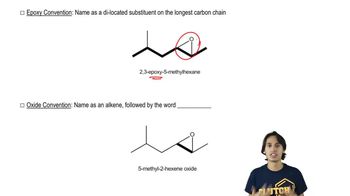
    The epoxy group is treated as a substituent, and its position is specified by the two carbons it bridges (e.g., 2,3-epoxy).
  • In the epoxy convention, how do you determine the numbering for the epoxy group?

    Number the longest carbon chain to give the epoxy group the lowest possible numbers, specifying both attachment points.
  • What is the historical method for naming epoxides based on alkenes?

    Name the compound as if it were an alkene, then add 'oxide' at the end to indicate the epoxide formation.
  • How would you name a compound using the alkene oxide method if the double bond is between carbons 2 and 3?

    You would name it as 2-hexene oxide, not 2,3-hexene oxide.
  • When using the epoxy convention, how do you indicate a methyl group at position 5?

    You include it as a substituent in the name, such as 5-methyl-2,3-epoxyhexane.
  • What additional information might be required in epoxide naming if stereochemistry is relevant?

    You may need to specify stereochemistry using terms like cis and trans if required by your professor.
  • Why is it important not to confuse the numbering in the epoxy convention with the alkene oxide method?

    Because the epoxy convention specifies both carbons the oxygen bridges, while the alkene oxide method uses the lowest number for the double bond location.