Back

Naming Thiols quiz

Control buttons has been changed to "navigation" mode.
1/15
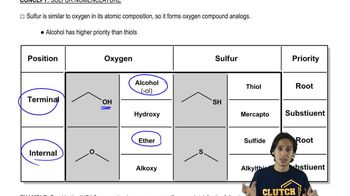
  • Why are sulfur-containing compounds named similarly to oxygen-containing compounds?

    Because sulfur is directly below oxygen on the periodic table, leading to similar chemical behavior and naming conventions.
  • What is the sulfur analog of an alcohol called when it is the main functional group?

    It is called a thiol.
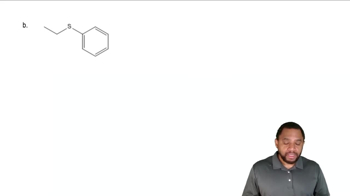
  • What is the sulfur analog of an ether called?

    It is called a sulfide.
  • When an alcohol is not the highest priority group, what prefix is used to name it as a substituent?

    The prefix 'hydroxy' is used.
  • When a thiol is not the highest priority group, what prefix is used to name it as a substituent?

    The prefix 'mercapto' is used.
  • What does the term 'mercapto' mean and where does it come from?

    'Mercapto' means sulfur in Latin and is used for thiol substituents.
  • How is a sulfide structurally similar to an ether?

    A sulfide has the structure R–S–R, analogous to an ether's R–O–R.
  • In the IUPAC system, how is an ether substituent named?

    It is named as an alkoxy group.
  • In the IUPAC system, how is a sulfide substituent named?

    It is named as an alkyl thiol group.
  • Which functional group has higher naming priority: alcohol or thiol?

    Alcohol has higher priority than thiol.
  • What suffix is used for the root name of a compound with a terminal sulfur group?

    The suffix '-thiol' is used.
  • What suffix is used for the root name of a compound with a terminal oxygen group?

    The suffix '-ol' is used.
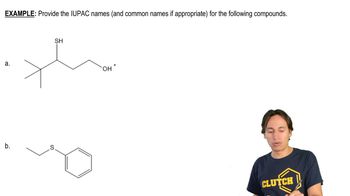
  • If both a carboxylic acid and a thiol are present, which group determines the root name?

    The carboxylic acid determines the root name because it has higher priority.
  • What is the general formula for a sulfide?

    The general formula is R–S–R.
  • Why is it helpful to compare sulfur nomenclature to oxygen nomenclature?

    Because the similarities in their chemistry and naming conventions make it easier to learn the rules for sulfur compounds by analogy.