Back

Oxidative Cleavage definitions

Control buttons has been changed to "navigation" mode.
1/14
  • Oxidative Cleavage

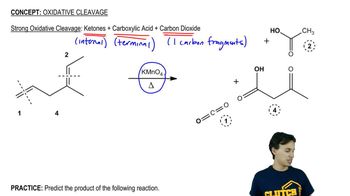
    A reaction where double bonds are split into fragments by adding oxygen, typically using hot KMnO4.
  • Potassium Permanganate

    A strong oxidizing agent that, when heated, slices double bonds, forming new oxygen-containing fragments.
  • Double Bond

    A region in a molecule where two atoms share two pairs of electrons, susceptible to cleavage by oxidants.
  • Internal Alkene

    A double bond flanked by alkyl groups on both sides, leading to ketone formation upon oxidative cleavage.
  • Terminal Alkene

    A double bond at the end of a carbon chain with at least one hydrogen, yielding carboxylic acids after cleavage.
  • Ketone

    A product formed when both sides of a cleaved double bond are attached to alkyl groups, containing a carbonyl group.
  • Carboxylic Acid

    A product formed from a terminal alkene with at least one hydrogen, featuring a carbonyl and hydroxyl group.
  • Carbon Dioxide

    A fully oxidized, inorganic carbon fragment produced from single-carbon cleavage with two hydrogens.
  • Syn Diol Addition

    A reaction at low temperatures where KMnO4 adds two hydroxyl groups to the same side of a double bond.
  • Fragment

    A piece of a molecule generated after the double bond is split during oxidative cleavage.
  • Alkyl Group

    A hydrocarbon substituent attached to a double bond, influencing the product type after cleavage.
  • Hydrogen Atom

    A determinant for the product type in oxidative cleavage, with its presence or absence guiding product formation.
  • Geometric Consideration

    The spatial arrangement of atoms, affecting how rings or chains are split and what fragments result.
  • Inorganic Carbon

    A form of carbon, such as in carbon dioxide, lacking hydrogen and resulting from complete oxidation.