Back

Oxymercuration definitions

Control buttons has been changed to "navigation" mode.
1/15
  • Oxymercuration

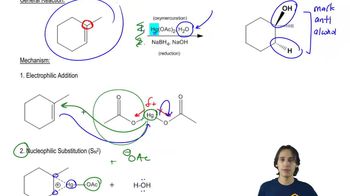
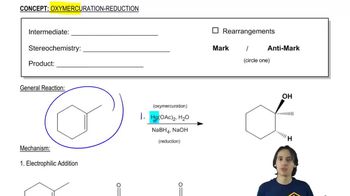
    A method for adding alcohols to double bonds using mercury(II) acetate and water, forming a Markovnikov alcohol without carbocation rearrangement.
  • Demercuration

    The reduction step where mercury is replaced by hydrogen, typically using sodium borohydride, finalizing alcohol formation.
  • Mercury(II) Acetate

    A reagent with two acetyl groups attached to mercury, serving as the electrophile in the initial addition to alkenes.
  • Sodium Borohydride

    A reducing agent that replaces mercury with hydrogen in the final step, completing the transformation to alcohol.
  • Bridged Ion

    An unstable, three-membered intermediate where mercury connects to two carbons, distributing a positive charge.
  • Mercurinium Ion

    A specific type of bridged ion formed when mercury bonds to both carbons of a former double bond, creating partial positive charges.
  • Markovnikov Addition

    A regiochemical outcome where the nucleophile attaches to the more substituted carbon of the double bond.
  • Anti Addition

    A stereochemical result where new groups added to a double bond end up on opposite sides, or trans to each other.
  • Nucleophile

    A species, such as water in this reaction, that donates electrons to attack a positively charged or electron-deficient center.
  • Electrophilic Addition

    A reaction type where an electron-rich double bond attacks an electron-poor species, initiating the mechanism.
  • Carbocation Rearrangement

    A process absent in this reaction, since no carbocation intermediate forms, ensuring predictable product structure.
  • Alcohol

    The functional group produced by this reaction, resulting from water's nucleophilic attack on the bridged intermediate.
  • Acetyl Group

    A functional group attached to mercury in the initial reagent, influencing its electrophilicity.
  • Reduction

    The chemical process in the second step where mercury is replaced by hydrogen, finalizing the alcohol product.
  • Base

    A substance, such as NaOH, used in the reduction step to deprotonate water, facilitating alcohol formation.