Back

Oxymercuration quiz

Control buttons has been changed to "navigation" mode.
1/15
  • What are the two main reagents used in the oxymercuration-demercuration reaction?

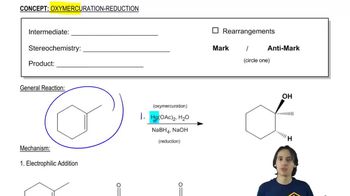
    The two main reagents are mercury(II) acetate (Hg(OAc)2) and sodium borohydride (NaBH4).
  • What is the role of water in the oxymercuration-demercuration reaction?

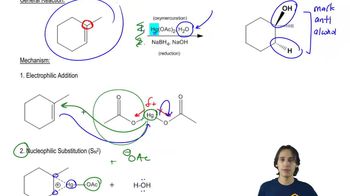
    Water acts as the nucleophile, attacking the more positively charged carbon of the bridged mercurinium ion.
  • What type of intermediate is formed during the oxymercuration step?

    A bridged mercurinium ion intermediate is formed, not a carbocation.
  • Does the oxymercuration-demercuration reaction follow Markovnikov's rule?

    Yes, the alcohol adds to the more substituted (Markovnikov) carbon.
  • Why are there no carbocation rearrangements in oxymercuration-demercuration?

    There are no carbocations formed, so rearrangements cannot occur.
  • What is the stereochemistry of the product in oxymercuration-demercuration?

    The product has anti stereochemistry, meaning the H and OH are added trans to each other.
  • What does the reduction (demercuration) step accomplish in this reaction?

    The reduction step replaces the mercury group with a hydrogen atom, completing the formation of the alcohol.
  • What is the function of NaBH4 in the reaction?

    NaBH4 acts as a reducing agent, removing the mercury and replacing it with hydrogen.
  • How does the double bond interact with mercury(II) acetate in the first step?

    The double bond attacks the electrophilic mercury, forming a bridged mercurinium ion.
  • Why does water attack the more substituted carbon of the mercurinium ion?

    The more substituted carbon has greater positive character and is more stable for nucleophilic attack.
  • What happens to the bond angles when the three-membered ring opens?

    The ring strain is relieved, and the groups added end up on opposite sides (anti addition).
  • Is knowledge of the detailed reduction mechanism required for oxymercuration-demercuration?

    No, you only need to know that NaBH4 reduces the mercury to hydrogen; the detailed mechanism is not required.
  • What is the general outcome of oxymercuration-demercuration on an alkene?

    An alcohol is added to the more substituted carbon with anti stereochemistry and no rearrangement.
  • How can you recognize an oxymercuration reaction in a problem?

    Look for the presence of Hg(OAc)2 and NaBH4 as reagents.
  • What is the significance of anti addition in the context of this reaction?

    Anti addition means the H and OH are added to opposite sides of the former double bond, resulting in trans products.