Back

Peptide Sequencing: Partial Hydrolysis definitions

Control buttons has been changed to "navigation" mode.
1/15
  • Partial Hydrolysis

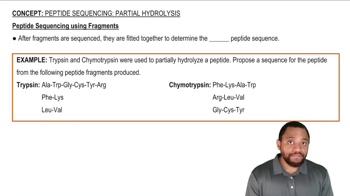
    Process using specific enzymes to break peptide chains into smaller fragments without fully degrading them.
  • Endopeptidase

    Enzyme that selectively cleaves internal peptide bonds at specific amino acids, generating peptide fragments.
  • Trypsin

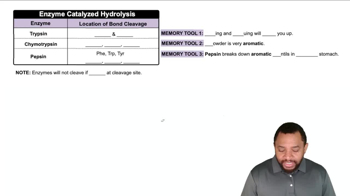
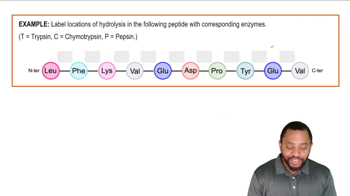
    Enzyme that cleaves peptide bonds at the carboxyl side of lysine and arginine residues.
  • Chymotrypsin

    Enzyme that targets peptide bonds adjacent to aromatic amino acids like phenylalanine, tryptophan, and tyrosine.
  • Pepsin

    Enzyme that cleaves peptide bonds near aromatic, leucine, aspartic acid, and glutamic acid residues, especially in acidic conditions.
  • Proline

    Amino acid that prevents enzymatic cleavage at its position due to its unique cyclic structure.
  • Exopeptidase

    Enzyme that removes amino acids from the ends of peptide chains, acting at terminal positions.
  • Carboxypeptidase A

    Exopeptidase that removes C-terminal amino acids except for lysine and arginine.
  • Carboxypeptidase B

    Exopeptidase that specifically removes C-terminal lysine and arginine residues.
  • Complete Hydrolysis

    Total breakdown of peptide bonds by boiling in strong acid, yielding free amino acids for analysis.
  • Ion Exchange Chromatography

    Analytical technique separating amino acids based on charge, used to determine their composition after hydrolysis.
  • Peptide Bond

    Covalent linkage between amino acids in a peptide chain, targeted by hydrolytic enzymes.
  • Aromatic Amino Acid

    Amino acid with an aromatic side chain, such as phenylalanine, tryptophan, or tyrosine, often targeted by chymotrypsin.
  • C Terminus

    End of a peptide chain featuring a free carboxyl group, site of exopeptidase activity.
  • Amino Acid Composition

    Profile of individual amino acids present in a peptide, determined after complete hydrolysis.