Back

Peptide Sequencing: Partial Hydrolysis quiz

Control buttons has been changed to "navigation" mode.
1/15
  • What is the purpose of partial hydrolysis in peptide sequencing?

    Partial hydrolysis breaks peptides into smaller fragments, allowing for controlled analysis of peptide structure and sequence.
  • How do endopeptidases differ from random acid hydrolysis?

    Endopeptidases selectively cleave peptide bonds at specific amino acids, while acid hydrolysis cleaves at random sites.
  • Which amino acids does trypsin specifically cleave after?

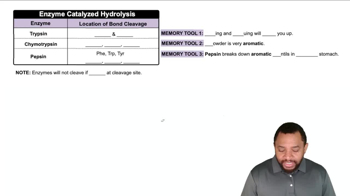
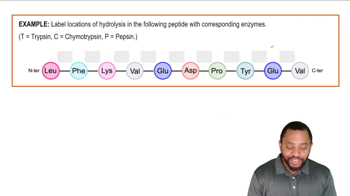
    Trypsin cleaves peptide bonds after lysine and arginine residues.
  • What is the memory tool for remembering trypsin’s specificity?

    The phrase 'lying and arguing will trip you up' helps recall that trypsin cleaves after lysine and arginine.
  • Which amino acids are targeted by chymotrypsin?

    Chymotrypsin cleaves after phenylalanine, tryptophan, and tyrosine, which all have aromatic side chains.
  • What is the memory tool for chymotrypsin’s specificity?

    'Chowder is very aromatic' helps remember that chymotrypsin targets aromatic amino acids.
  • Name the amino acids pepsin can cleave after.

    Pepsin cleaves after phenylalanine, tryptophan, tyrosine, leucine, aspartic acid, and glutamic acid.
  • Why can’t endopeptidases cleave at sites near proline?

    Endopeptidases cannot cleave if proline is at the cleavage site due to its unique structure, which hinders enzyme access.
  • What is the role of exopeptidases in peptide sequencing?

    Exopeptidases hydrolyze peptide bonds at the C-terminus, removing terminal amino acids for sequence analysis.
  • How does carboxypeptidase A differ from carboxypeptidase B?

    Carboxypeptidase A removes most C-terminal amino acids except arginine and lysine, while carboxypeptidase B specifically removes C-terminal arginine and lysine.
  • What is the main purpose of complete hydrolysis in peptide analysis?

    Complete hydrolysis breaks all peptide bonds, releasing individual amino acids for identification and quantification.
  • How are amino acids analyzed after complete hydrolysis?

    The amino acid mixture is separated and quantified using ion exchange chromatography.
  • Why doesn’t complete hydrolysis provide the amino acid sequence?

    Complete hydrolysis only reveals the composition of amino acids, not their order in the peptide chain.
  • How is peptide sequence determined using hydrolysis data?

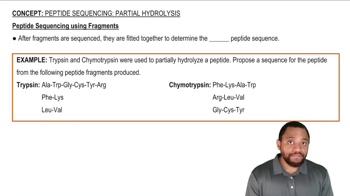
    Sequence is determined by combining data from partial hydrolysis fragments and complete hydrolysis amino acid composition.
  • Why is understanding enzyme specificity important in peptide sequencing?

    Knowing enzyme specificity allows for controlled cleavage, which is essential for accurately determining peptide structure and sequence.