Back

Peptides definitions

Control buttons has been changed to "navigation" mode.
1/14
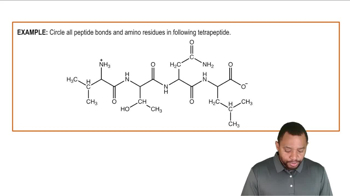
  • Peptide Bond

    A covalent linkage formed between the carboxyl group of one amino acid and the amino group of another, resulting in water loss.
  • Amide Bond

    A type of covalent bond identical to a peptide bond, connecting amino acids in peptides and proteins.
  • Condensation Reaction

    A chemical process where two molecules join, releasing a water molecule, as seen in peptide formation.
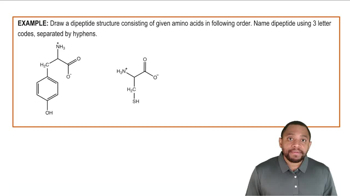
  • Dipeptide

    A molecule consisting of two amino acids joined by a single peptide bond, often represented with a hyphen.
  • Polypeptide

    A chain composed of many amino acid residues linked by peptide bonds, forming the backbone of proteins.
  • Residue

    An individual amino acid unit within a peptide or protein chain after water is removed during bond formation.
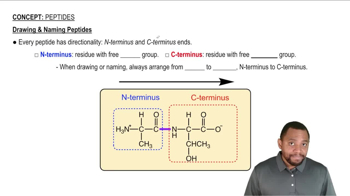
  • N Terminus

    The end of a peptide chain with a free amino group, typically drawn or written on the left.
  • C Terminus

    The end of a peptide chain with a free carboxyl group, usually positioned on the right in diagrams.
  • Directionality

    The specific orientation of a peptide chain, always read from the N terminus to the C terminus.
  • Carboxyl Group

    A functional group (-COOH) in amino acids that forms peptide bonds by reacting with amino groups.
  • Amino Group

    A functional group (-NH2) in amino acids that participates in peptide bond formation with carboxyl groups.
  • Tripeptide

    A peptide composed of three amino acid residues linked by two peptide bonds.
  • Tetra Peptide

    A peptide containing four amino acid residues connected by three peptide bonds.
  • Hyphen

    A symbol used in peptide notation to indicate a peptide bond between amino acid abbreviations.