Back

Photochemical Cycloaddition Reactions quiz

Control buttons has been changed to "navigation" mode.
1/15
  • What activates a photochemical cycloaddition reaction?

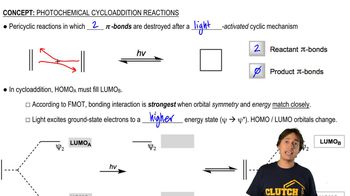
    Photochemical cycloadditions are activated by light, not heat, which initiates a cyclic mechanism.
  • What is the product formed when two alkenes undergo photochemical cycloaddition?

    The product is a cyclobutane, formed by the destruction of two pi bonds.
  • How does the mechanism of photochemical cycloaddition proceed?

    The mechanism is cyclic and concerted, with new single bonds forming simultaneously.
  • What theory is used to predict the feasibility of cycloaddition reactions?

    Frontier Molecular Orbital Theory (FMOT) is used to predict if cycloadditions are feasible.
  • What must happen between molecular orbitals for a cycloaddition to occur?

    A HOMO must fill a LUMO with matching orbital symmetry and similar energy levels.
  • How does light affect the molecular orbitals in a conjugated system during photochemical cycloaddition?

    Light excites electrons from the HOMO to the LUMO, changing the identities and energies of the orbitals.
  • Why can photochemical cycloadditions be symmetry allowed when thermal cycloadditions are not?

    Light changes the symmetry of molecular orbitals, making reactions symmetry allowed under photochemical conditions.
  • What is the difference between suprafacial and antarafacial interactions?

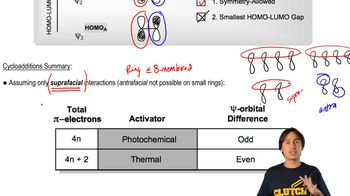
    Suprafacial interactions occur on one side of each molecular orbital, while antarafacial interactions involve different sides and require larger molecules.
  • For rings of what size are only suprafacial interactions possible?

    Rings with 8 members or fewer can only undergo suprafacial interactions.
  • How can you predict whether a cycloaddition requires photochemical or thermal conditions using pi electrons?

    If the total pi electrons are a multiple of 4n, photochemical conditions are needed; if 4n+2, thermal conditions are required.
  • What is an example of a reaction that requires thermal conditions based on pi electron count?

    The Diels-Alder reaction, with 6 pi electrons, requires thermal conditions.
  • What shortcut can be used to determine if a cycloaddition is symmetry allowed?

    Calculate the difference between Psi orbital numbers; odd differences require photochemical energy, even differences allow thermal conditions.
  • What happens to the HOMO and LUMO gap in photochemical cycloaddition between identical molecules?

    The HOMO and LUMO gap becomes almost zero, making the reaction highly favorable.
  • Why is the 2 pi + 2 pi cycloaddition symmetry allowed under photochemical but not thermal conditions?

    Photochemical excitation changes orbital symmetry, allowing the reaction, whereas thermal conditions do not.
  • What is the fastest way to determine if a cycloaddition is symmetry allowed or disallowed?

    Count the total pi electrons and check if the reaction is under photochemical or thermal conditions.