Organic Chemistry
My Course
Learn
Exam Prep
AI Tutor
Study Guides
Textbook Solutions
Flashcards
Explore
My Course
Learn
Exam Prep
AI Tutor
Study Guides
Textbook Solutions
Flashcards
Explore
Back
Polymers Structure and Properties quiz
You can tap to flip the card.
Define:
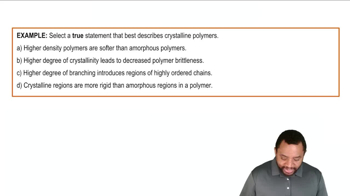
What is the effect of increased crystallinity on the density of a polymer?
You can tap to flip the card.
👆
What is the effect of increased crystallinity on the density of a polymer?
Increased crystallinity raises the density of a polymer because the ordered regions pack more closely together.
Track progress
Control buttons has been changed to "navigation" mode.
1/15
Related flashcards
Recommended videos
Polymers Structure and Properties definitions
Polymers Structure and Properties
15 Terms
Guided course
1:19
Polymers Structure and Properties Concept 1
Johnny Betancourt
401
views
Guided course
1:21
Polymers Structure and Properties Example 1
Johnny Betancourt
379
views
Guided course
00:37
Polymers Structure and Properties Concept 2
Johnny Betancourt
370
views
Terms in this set (15)
Hide definitions
What is the effect of increased crystallinity on the density of a polymer?
Increased crystallinity raises the density of a polymer because the ordered regions pack more closely together.
How do amorphous regions differ from crystalline regions in polymers?
Amorphous regions have disordered polymer chains, while crystalline regions have ordered, linear arrangements.
What is a crystallite in the context of polymers?
A crystallite is a small, ordered region within a polymer that contributes to its overall crystallinity.
How does crystallinity affect the rigidity of a polymer?
Higher crystallinity increases the rigidity of a polymer due to stronger intermolecular interactions in ordered regions.
What is the relationship between crystallinity and polymer strength?
As crystallinity increases, the strength of the polymer also increases.
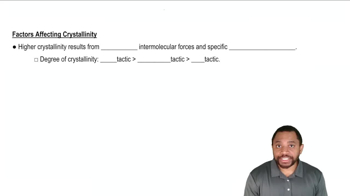
Which type of stereochemistry leads to the highest degree of crystallinity in polymers?
Isotactic stereochemistry leads to the highest degree of crystallinity.
Rank the following in order of decreasing crystallinity: isotactic, syndiotactic, atactic.
Isotactic > syndiotactic > atactic.
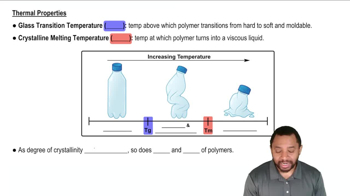
What is the glass transition temperature (Tg) in polymers?
Tg is the temperature above which a polymer transitions from hard to soft and moldable.
What happens to a polymer when it is heated above its glass transition temperature (Tg)?
The polymer becomes soft and moldable above its Tg.
What is the crystalline melting temperature (Tm) in polymers?
Tm is the temperature at which a polymer turns into a viscous liquid.
How does increasing crystallinity affect the glass transition temperature (Tg) and melting temperature (Tm)?
Increasing crystallinity raises both Tg and Tm.
Why does higher crystallinity require higher temperatures for phase transitions in polymers?
Stronger intermolecular bonding in crystalline regions requires more energy (higher temperature) to transition phases.
What physical changes occur to a polymer as it is heated from below Tg to above Tm?
It changes from hard to soft and moldable at Tg, and then to a viscous liquid at Tm.
How do intermolecular forces influence polymer crystallinity?
Stronger intermolecular forces promote higher crystallinity in polymers.
Why is understanding crystallinity important for polymer applications?
Crystallinity determines key properties like density, rigidity, strength, and thermal behavior, which are crucial for polymer use.