Back

Primary Protein Structure definitions

Control buttons has been changed to "navigation" mode.
1/13
  • Primary Structure

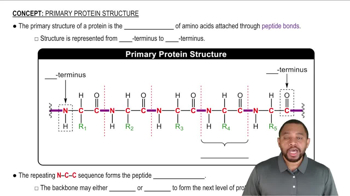
    Linear sequence of amino acids in a protein, determining its unique characteristics and function.
  • Amino Acid

    Organic molecule serving as the building block of proteins, each with a central carbon, amino group, and carboxyl group.
  • Peptide Bond

    Covalent linkage joining amino acids, formed between the amino group of one and the carboxyl group of another.
  • N Terminus

    End of a protein or peptide chain featuring a free amino group, marking the starting point of the sequence.
  • C Terminus

    End of a protein or peptide chain with a free carboxyl group, indicating the sequence's conclusion.
  • Residue

    Individual amino acid unit within a polypeptide chain, remaining after peptide bond formation.
  • Peptide Backbone

    Repeating N-C-C sequence forming the structural framework of a protein chain.
  • Protein Sequence

    Order of amino acids in a polypeptide, read from the N terminus to the C terminus.
  • Polypeptide

    Chain of multiple amino acids linked by peptide bonds, forming the basis of protein structure.
  • Carboxyl Group

    Functional group (-COOH) present at the C terminus, contributing to peptide bond formation.
  • Amino Group

    Functional group (-NH2) present at the N terminus, initiating the protein sequence.
  • Sequence

    Specific linear arrangement of amino acids, crucial for protein identity and function.
  • Protein Function

    Biological role determined by the unique order of amino acids in the primary structure.