Organic Chemistry
My Course
Learn
Exam Prep
AI Tutor
Study Guides
Textbook Solutions
Flashcards
Explore
My Course
Learn
Exam Prep
AI Tutor
Study Guides
Textbook Solutions
Flashcards
Explore
Back
Quaternary Protein Structure definitions
You can tap to flip the card.
Define:
Quaternary Structure
You can tap to flip the card.
👆
Quaternary Structure
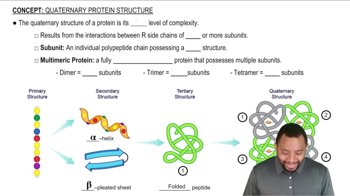
Highest protein complexity, formed by interactions among side chains of multiple polypeptide subunits.
Track progress
Control buttons has been changed to "navigation" mode.
1/15
Related flashcards
Recommended videos
Quaternary Protein Structure quiz
Quaternary Protein Structure
10 Terms
Guided course
3:26
Quaternary Protein Structure Concept 1
Johnny Betancourt
559
views
1
rank
Guided course
1:13
Quaternary Protein Structure Example 1
Johnny Betancourt
584
views
Terms in this set (15)
Hide definitions
Quaternary Structure
Highest protein complexity, formed by interactions among side chains of multiple polypeptide subunits.
Subunit
Individual polypeptide chain with its own tertiary structure, contributing to a larger protein complex.
Multimeric Protein
Functional protein composed of two or more subunits, often classified by the number of subunits present.
Dimer
Protein complex consisting of exactly two subunits interacting to form a functional unit.
Trimer
Protein assembly made up of three subunits, each contributing to the overall structure.
Tetramer
Protein structure composed of four subunits, often seen in biologically important molecules.
Tertiary Structure
Three-dimensional folding of a single polypeptide chain, stabilized by side chain interactions.
Hydrophobic Interaction
Nonpolar side chains clustering together within a protein, driving folding and stability.
Hydrogen Bonding
Attractive force between a hydrogen atom and an electronegative atom, stabilizing protein structure.
Prosthetic Group
Non-amino acid component permanently attached to a protein, essential for its biological function.
Heme Group
Iron-containing prosthetic group found in hemoglobin, crucial for oxygen transport in cells.
Primary Structure
Linear sequence of amino acids in a polypeptide, linked by peptide bonds.
Secondary Structure
Regular folding patterns within a polypeptide, such as alpha helices and beta pleated sheets.
Alpha Helix
Coiled secondary structure stabilized by hydrogen bonds within a single polypeptide chain.
Beta Pleated Sheet
Sheet-like secondary structure formed by hydrogen bonds between different segments of a polypeptide.