Back

Reducing Sugars definitions

Control buttons has been changed to "navigation" mode.
1/15
  • Reducing Sugar

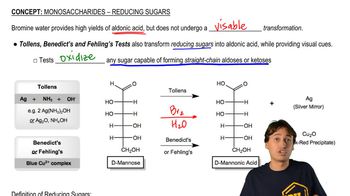
    Any carbohydrate capable of being oxidized to an acid, typically by forming a straight chain aldose or ketose.
  • Aldose

    A monosaccharide with an aldehyde group in its straight chain form, readily oxidized in classic sugar tests.
  • Ketose

    A monosaccharide with a ketone group, able to tautomerize to an aldose under basic conditions for oxidation.
  • Tollens Test

    A reaction using silver, ammonia, and base that forms a silver mirror to indicate the presence of certain sugars.
  • Benedict's Test

    A copper-based assay that turns from blue to brick red, signaling the presence of oxidizable sugars.
  • Fehling's Test

    A copper(II) complex test producing a brick red Cu2O precipitate when specific sugars are present.
  • Aldonic Acid

    The oxidation product of an aldose, formed during reactions with Tollens, Benedict's, or Fehling's reagents.
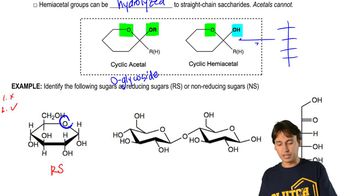
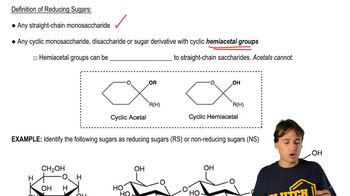
  • Hemiacetal

    A cyclic structure with one OR and one OH group on the same carbon, allowing interconversion with straight chain forms.
  • Acetal

    A structure with two OR groups on the same carbon, locking sugars in a non-reducing, stable form.
  • Glycoside

    A sugar derivative where the anomeric carbon is part of an acetal, preventing easy hydrolysis to the straight chain.
  • Tautomerization

    A base-catalyzed process where a ketose rearranges to an aldose, enabling oxidation in sugar tests.
  • Cu2O

    A brick red precipitate formed in Benedict's and Fehling's tests, indicating the oxidation of a sugar.
  • Monosaccharide

    A single sugar unit, either straight chain or cyclic, that can often act as a reducing sugar.
  • Hydrolysis

    A reaction where water breaks a bond, allowing cyclic hemiacetals to revert to straight chain forms.
  • Silver Mirror

    A shiny deposit on glassware, visually confirming the presence of oxidizable sugars in the Tollens test.