Back

Reducing Sugars quiz

Control buttons has been changed to "navigation" mode.
1/15
  • What is the definition of a reducing sugar?

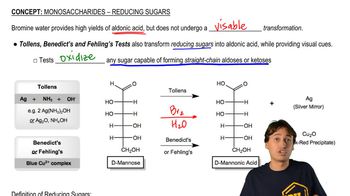
    A reducing sugar is any sugar capable of forming a straight chain aldose or ketose.
  • Which three classical tests are used to detect reducing sugars?

    Tollens, Benedict's, and Fehling's tests are commonly used to detect reducing sugars.
  • What visual result does the Tollens test produce when a reducing sugar is present?

    The Tollens test produces a silver mirror on the test tube as a visual indication.
  • What is the visual cue for a positive Benedict's or Fehling's test?

    A brick red precipitate of copper(I) oxide (Cu2O) forms from a blue solution.
  • What is the main chemical component in Tollens reagent?

    Tollens reagent contains elemental silver, ammonia, and a base.
  • What type of sugar is always a reducing sugar in its straight chain form?

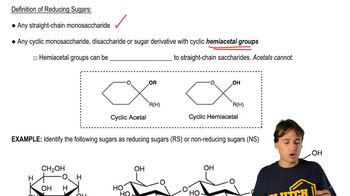
    Any straight chain monosaccharide, whether aldose or ketose, is a reducing sugar.
  • What structural feature must a cyclic sugar have to be considered a reducing sugar?

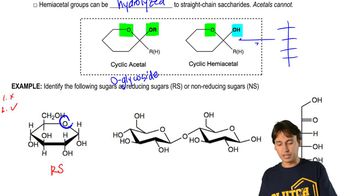
    It must have at least one cyclic hemiacetal group.
  • Why are cyclic hemiacetals considered reducing sugars?

    Because they can hydrolyze back to the straight chain form, allowing oxidation.
  • Why are acetals (glycosides) not considered reducing sugars?

    Acetals cannot hydrolyze back to the straight chain form under normal conditions, so they cannot be oxidized.
  • How can ketoses participate in oxidation reactions in these tests?

    Ketoses can tautomerize to aldoses in basic conditions, allowing them to be oxidized.
  • What is the misconception about the term 'reducing sugar'?

    Many think it means the sugar is reduced, but it actually refers to sugars that can be oxidized.
  • What is the product formed when a reducing sugar reacts in these tests?

    The sugar is oxidized to an aldonic acid.
  • What is the starting color and final color in Benedict's and Fehling's tests?

    The solution starts blue and turns brick red if a reducing sugar is present.
  • What is the difference between Benedict's and Fehling's tests?

    They use slightly different copper(II) complexes, but both detect reducing sugars with the same visual result.
  • Why is it important to recognize hemiacetals in sugar structures?

    Because the presence of a hemiacetal group indicates the sugar can revert to a straight chain form and act as a reducing sugar.