Back

Resonance Structures definitions

Control buttons has been changed to "navigation" mode.
1/15
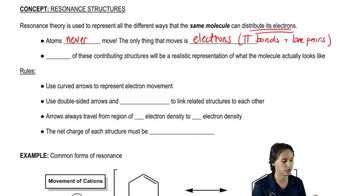
  • Resonance Theory

    A concept describing electron distribution variations in a molecule without altering atom connectivity.
  • Pi Bond

    A type of bond formed by sideways overlap of orbitals, allowing electron movement in resonance.
  • Lone Pair

    A set of valence electrons not involved in bonding, often relocated during resonance.
  • Curved Arrow

    A notation tool indicating the movement of two electrons from high to low electron density.
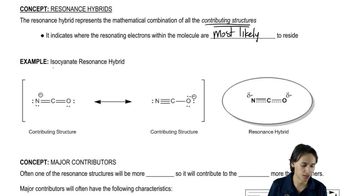
  • Contributing Structure

    An alternative electron arrangement that, when averaged, represents the actual molecule.
  • Resonance Hybrid

    A mathematical blend of all contributing structures, showing probable electron locations.
  • Cation

    A positively charged species, often involved in resonance by accepting electron density.
  • Anion

    A negatively charged species, typically donating electron pairs in resonance processes.
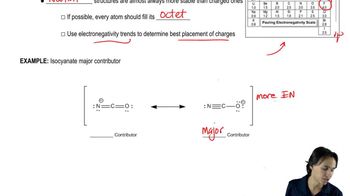
  • Octet Rule

    A stability guideline stating atoms prefer eight electrons in their valence shell during resonance.
  • Major Contributor

    The most stable resonance structure, usually neutral and fulfilling octet requirements.
  • Electronegativity

    A measure of an atom's tendency to attract electrons, influencing charge placement in resonance.
  • Double-Sided Arrow

    A symbol used to connect resonance structures, indicating their equivalence in electron distribution.
  • Bond Breaking

    A process required in some resonance patterns to preserve octets, especially with anions.
  • Partial Charge

    A fractional positive or negative charge shown in resonance hybrids, reflecting electron delocalization.
  • Heteroatom

    A non-carbon atom, such as oxygen or nitrogen, that can participate in resonance via lone pairs.