Back

Ring Strain quiz

Control buttons has been changed to "navigation" mode.
1/15
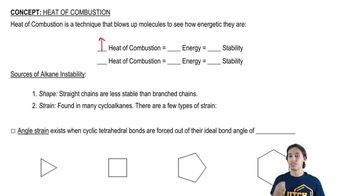
  • What does a higher heat of combustion indicate about a molecule's energy and stability?

    A higher heat of combustion means the molecule has higher energy and is less stable.
  • How are heat of combustion and molecular stability related?

    They are inversely related; higher heat of combustion means lower stability, and lower heat of combustion means higher stability.
  • Between straight-chain and branched alkanes, which is more stable and why?

    Branched alkanes are more stable than straight-chain alkanes, though the exact reason is complex and beyond the course scope.
  • What is angle strain in cycloalkanes?

    Angle strain occurs when bond angles deviate from the ideal tetrahedral angle of 109.5 degrees, causing instability.
  • Why do smaller cycloalkane rings experience more angle strain?

    Smaller rings force bond angles to be much less than 109.5 degrees, increasing strain and instability.
  • What is the bond angle in a cyclopropane ring, and how does it compare to the ideal tetrahedral angle?

    Cyclopropane has bond angles of 60 degrees, which is much less than the ideal 109.5 degrees, resulting in high angle strain.
  • How does the bond angle in cyclobutane compare to the ideal tetrahedral angle?

    Cyclobutane has bond angles of 90 degrees, which is still significantly less than 109.5 degrees, so it has angle strain.
  • What is the bond angle in cyclopentane, and how much angle strain does it have?

    Cyclopentane has bond angles of about 108 degrees, which is very close to 109.5 degrees, so it has very little angle strain.
  • Despite having bond angles of 120 degrees, why is cyclohexane the most stable cycloalkane?

    Cyclohexane is the most stable due to other stabilizing factors, even though its bond angles deviate from the ideal 109.5 degrees.
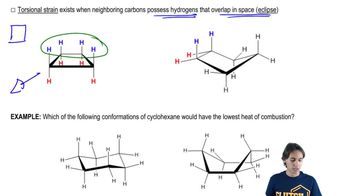
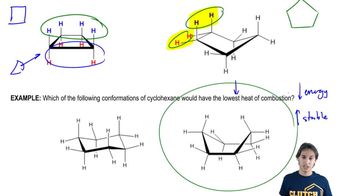
  • What is torsional strain and how does it arise?

    Torsional strain arises from eclipsed bonds, where hydrogens on adjacent carbons overlap in space, causing instability.
  • Which type of strain is the main source of instability in cyclopentane?

    Torsional strain is the main source of instability in cyclopentane due to some remaining eclipsed hydrogens.
  • How does cyclopentane attempt to reduce torsional strain?

    Cyclopentane bends out of the plane to minimize eclipsed bonds, but some torsional strain remains.
  • What is the relationship between ring size and angle strain in cycloalkanes?

    As ring size increases, angle strain generally decreases because bond angles approach the ideal 109.5 degrees.
  • Why is a straight-chain alkane less stable than a branched-chain alkane of the same carbon count?

    A straight-chain alkane is less stable and has higher energy, though the detailed reasons are complex and not fully understood.
  • What happens to the stability of a molecule as its heat of combustion decreases?

    As heat of combustion decreases, the molecule becomes more stable.