Organic Chemistry
My Course
Learn
Exam Prep
AI Tutor
Study Guides
Textbook Solutions
Flashcards
Explore
Try the app
My Course
Learn
Exam Prep
AI Tutor
Study Guides
Textbook Solutions
Flashcards
Explore
Try the app
Back
Robinson Annulation quiz
You can tap to flip the card.
What is the Robinson annulation reaction used to synthesize?
You can tap to flip the card.
👆
What is the Robinson annulation reaction used to synthesize?
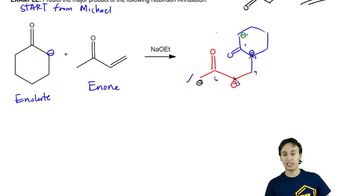
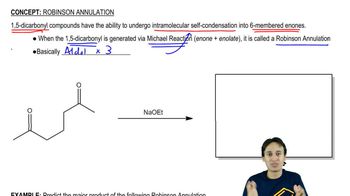
It is used to synthesize six-membered cyclic enones from 1,5-dicarbonyl compounds formed via a Michael reaction.
Track progress
Control buttons has been changed to "navigation" mode.
1/15
Related flashcards
Related practice
Recommended videos
Robinson Annulation definitions
Robinson Annulation
15 Terms
Michael Addition
25. Condensation Chemistry
7 problems
Topic
Laura
22. Condensation Chemistry - Part 1 of 2
3 topics
9 problems
Chapter
Ernest
22. Condensation Chemistry - Part 2 of 2
3 topics
9 problems
Chapter
Johnny
Guided course
05:00
Predict the Major Product
1424
views
11
rank
7
comments
Guided course
04:12
Robinson Annulation
1748
views
9
rank
9
comments
Terms in this set (15)
Hide definitions
What is the Robinson annulation reaction used to synthesize?
It is used to synthesize six-membered cyclic enones from 1,5-dicarbonyl compounds formed via a Michael reaction.
What type of compound undergoes cyclization in the Robinson annulation?
A 1,5-dicarbonyl compound undergoes cyclization to form a six-membered ring.
How is the Robinson annulation described in terms of aldol reactions?
It is described as 'Aldol times three' because it involves three aldol-related steps: enone formation, Michael addition, and cyclization.
What is the role of the Michael reaction in Robinson annulation?
The Michael reaction forms the 1,5-dicarbonyl intermediate needed for the annulation.
Why is the strategic selection of the Michael addition site important?
Choosing the correct site ensures the formation of a six-membered ring rather than a smaller ring.
What functional groups are typically found on the newly formed ring in Robinson annulation?
The ring usually contains a ketone, an alcohol, and a methyl group.
What step follows the formation of the six-membered ring in Robinson annulation?
A dehydration step typically follows, resulting in a cyclic enone.
What is the starting material for the Robinson annulation reaction?
The starting material is a Michael reaction product, which is a 1,5-dicarbonyl compound.
What is the key transformation in the Robinson annulation?
The key transformation is the intramolecular cyclization of the 1,5-dicarbonyl to form a six-membered ring.
How do you determine which enolate position to use for cyclization?
You select the enolate position that will result in a six-membered ring upon cyclization.
What is the final product of Robinson annulation after dehydration?
The final product is a cyclic enone with a methyl group and a double bond.
What is the significance of numbering the atoms when drawing the Robinson annulation product?
Numbering helps identify the positions of key functional groups and ensures correct ring formation.
What is the relationship between the Michael reaction and Robinson annulation?
The Michael reaction creates the 1,5-dicarbonyl intermediate necessary for Robinson annulation.
What is the typical sequence of reactions in Robinson annulation?
The sequence is enone formation, Michael addition, cyclization, and dehydration.
Why is practice important when learning Robinson annulation?
Practice helps students understand the sequence and transformations involved in the reaction.