Back

Sharpless Epoxidation quiz

Control buttons has been changed to "navigation" mode.
1/15
  • What type of selectivity does the Sharpless Asymmetric Epoxidation exhibit?

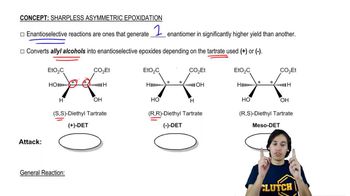
    It exhibits enantioselectivity, producing one enantiomer in excess over the other.
  • What functional group must be present in the substrate for Sharpless Epoxidation to occur?

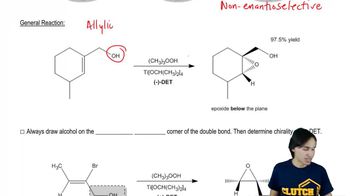
    The substrate must be an allylic alcohol, which is an alcohol adjacent to a double bond.
  • What is the role of titanium in the Sharpless Epoxidation?

    Titanium acts as a catalyst in the reaction.
  • What does a positive DET (diethyl tartrate) do in the Sharpless Epoxidation?

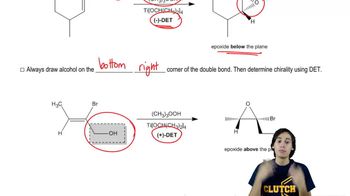
    Positive DET induces epoxidation from above the double bond, forming the epoxide on the top face.
  • How does negative DET affect the stereochemistry of the epoxide formed?

    Negative DET attacks from below the double bond, forming the epoxide on the bottom face.
  • What is the optical activity of a meso DET in Sharpless Epoxidation?

    Meso DET has no optical activity and does not induce enantioselectivity.
  • Why is the orientation of the allylic alcohol important in predicting the product of Sharpless Epoxidation?

    Consistent orientation (e.g., alcohol at the bottom right) helps accurately predict the stereochemistry of the epoxide formed.
  • What is the main advantage of using Sharpless Epoxidation in organic synthesis?

    It allows for the synthesis of chiral epoxides with defined stereochemistry.
  • What does the term 'asymmetric induction' refer to in the context of Sharpless Epoxidation?

    It refers to the process by which a chiral catalyst induces the formation of one enantiomer over the other.
  • What happens to the configuration of other substituents when the epoxide forms above or below the double bond?

    The configuration of other substituents remains the same; only the position of the epoxide changes.
  • How can you easily remember the effect of positive and negative DET in Sharpless Epoxidation?

    Positive DET adds the epoxide above the double bond, and negative DET adds it below.
  • Why is meso DET not commonly used in synthetic applications of Sharpless Epoxidation?

    Because it does not induce enantioselectivity, resulting in a racemic mixture.
  • What is the oxidizing agent typically used in Sharpless Epoxidation?

    A peroxide is used as the oxidizing agent.
  • How does the absolute configuration of the tartrate affect the optical rotation of the product?

    SS tartrate (positive) gives a product with positive optical rotation, while RR tartrate (negative) gives a product with negative rotation.
  • Why is it important to be consistent with the orientation of the alcohol when drawing Sharpless Epoxidation products?

    Consistency ensures correct prediction of the stereochemistry of the resulting epoxide.