Skip to main content
Organic Chemistry
My Course
Learn
Exam Prep
AI Tutor
Study Guides
Textbook Solutions
Flashcards
Explore
Try the app
My Course
Learn
Exam Prep
AI Tutor
Study Guides
Textbook Solutions
Flashcards
Explore
Try the app
Back
SN2 Reaction definitions
You can tap to flip the card.
SN2 Mechanism
You can tap to flip the card.
👆
SN2 Mechanism
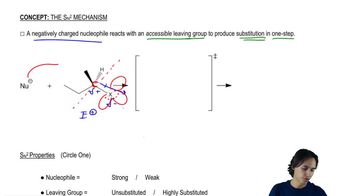
A one-step substitution process where a nucleophile attacks an electrophilic carbon, causing simultaneous bond formation and breaking.
Track progress
Control buttons has been changed to "navigation" mode.
1/15
Related flashcards
Related practice
Recommended videos
SN2 Reaction quiz #1
The SN2 Mechanism
18 Terms
SN2 Reaction
7. Substitution Reactions
7 problems
Topic
Johnny
SN1 Reaction
7. Substitution Reactions
7 problems
Topic
Ernest
7. Substitution Reactions
5 topics
15 problems
Chapter
Johnny
04:03
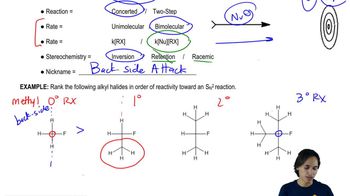
Ranking reactivity toward SN2
6454
views
69
rank
7
comments
08:33
Drawing the SN2 Mechanism
9038
views
134
rank
28
comments
11:57
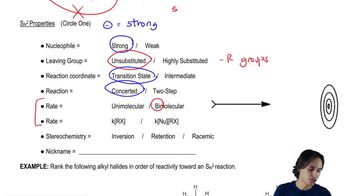
Understanding the properties of SN2.
7394
views
79
rank
20
comments
Terms in this set (15)
Hide definitions
SN2 Mechanism
A one-step substitution process where a nucleophile attacks an electrophilic carbon, causing simultaneous bond formation and breaking.
Nucleophile
A negatively charged species with extra electrons, seeking to donate them to an electrophilic center.
Electrophile
A site, often a carbon bonded to a halogen, that is electron-deficient and targeted by nucleophiles.
Leaving Group
An atom or group, typically a halide, that departs with a pair of electrons during substitution.
Backside Attack
An approach of a nucleophile from the side opposite the leaving group, avoiding electron repulsion.
Transition State
A high-energy, fleeting arrangement where bonds are partially formed and broken, never isolatable.
Bimolecular Reaction
A process where the reaction rate depends on the concentrations of both the nucleophile and the electrophile.
Alkyl Halide
A molecule containing a carbon bonded to a halogen, serving as a common substrate in substitution.
Steric Hindrance
Physical crowding around a reactive site, often by bulky groups, that impedes nucleophilic attack.
Inversion of Configuration
A stereochemical outcome where the spatial arrangement at a chiral center is flipped during substitution.
Chiral Center
A carbon atom bonded to four different groups, leading to non-superimposable mirror images.
Concerted Mechanism
A reaction pathway where bond-making and bond-breaking occur simultaneously in a single step.
Substitution Reaction
A process where one group replaces another on a molecule, often involving nucleophiles and leaving groups.
Unsubstituted Carbon
A carbon atom with few or no bulky groups attached, making it more accessible for nucleophilic attack.
Energy Diagram
A graphical representation showing the energy changes during a reaction, highlighting the transition state.
 BackBack

 04:03
04:03