Organic Chemistry
My Course
Learn
Exam Prep
AI Tutor
Study Guides
Textbook Solutions
Flashcards
Explore
Try the app
My Course
Learn
Exam Prep
AI Tutor
Study Guides
Textbook Solutions
Flashcards
Explore
Try the app
Back
Solvents definitions
You can tap to flip the card.
Solvent
You can tap to flip the card.
👆
Solvent
An inert compound serving as a medium for reactions, typically shown below the reaction arrow and not directly involved in the mechanism.
Track progress
Control buttons has been changed to "navigation" mode.
1/15
Related flashcards
Related practice
Recommended videos
Solvents quiz #1
Solvents
10 Terms
Solvents
8. Elimination Reactions
4 problems
Topic

Ernest
8. Elimination Reactions - Part 1 of 2
5 topics
11 problems
Chapter
Johnny
8. Elimination Reactions - Part 2 of 2
4 topics
10 problems
Chapter
Ernest
Guided course
03:57
The difference between protic vs. aprotic solvents.
4348
views
37
rank
9
comments
Guided course
01:16
Identification of polarity in solvents
3220
views
32
rank
3
comments
Guided course
00:39
Identification of polarity in solvents
2872
views
26
rank
2
comments
Terms in this set (15)
Hide definitions
Solvent
An inert compound serving as a medium for reactions, typically shown below the reaction arrow and not directly involved in the mechanism.
Polar Solvent
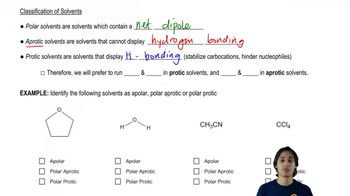
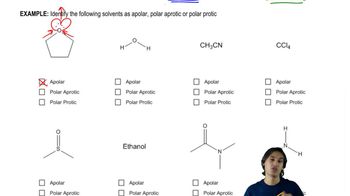
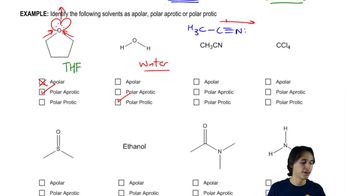
A molecule with a net dipole, influencing reaction environments by stabilizing charged intermediates.
Protic Solvent
A compound capable of hydrogen bonding, often containing O, N, or F, which stabilizes carbocations and slows nucleophiles.
Aprotic Solvent
A compound unable to hydrogen bond, allowing nucleophiles to react freely without hindrance.
Hydrogen Bonding
An interaction where a hydrogen atom is shared between electronegative atoms, crucial for protic solvent behavior.
Carbocation Stabilization
The effect where certain media reduce the energy of positively charged intermediates, favoring specific mechanisms.
Nucleophile
A species with a negative charge or lone pair, seeking to donate electrons, whose reactivity is influenced by the surrounding medium.
Leaving Group
A fragment that departs with a pair of electrons during a reaction, its importance often outweighing that of the medium.
SN1 Mechanism
A substitution pathway involving carbocation formation, favored by environments that stabilize positive charges.
SN2 Mechanism
A substitution pathway requiring unhindered nucleophiles, best performed in media that do not slow them down.
E1 Mechanism
An elimination pathway involving carbocation intermediates, promoted by environments that stabilize positive charges.
E2 Mechanism
An elimination pathway requiring strong nucleophiles, favored by media that do not hinder their movement.
Reaction Arrow
A notation in chemical equations, with the medium typically indicated below and the active reagent above.
Dipole
A separation of charge within a molecule, determining whether a medium is classified as polar.
Medium
The environment in which a chemical process occurs, often provided by an inert compound.