Skip to main content
Organic Chemistry
My Course
Learn
Exam Prep
AI Tutor
Study Guides
Textbook Solutions
Flashcards
Explore
Try the app
My Course
Learn
Exam Prep
AI Tutor
Study Guides
Textbook Solutions
Flashcards
Explore
Try the app
Back
Sphingomyelins definitions
You can tap to flip the card.
Sphingolipid
You can tap to flip the card.
👆
Sphingolipid
A lipid class featuring a sphingosine backbone, often involved in cell membrane structure and signaling.
Track progress
Control buttons has been changed to "navigation" mode.
1/13
Related flashcards
Related practice
Recommended videos
Sphingomyelins quiz
Sphingomyelins
15 Terms
Sphingomyelins
32. Lipids
5 problems
Topic
Steroids
32. Lipids
5 problems
Topic
32. Lipids - Part 1 of 3
4 topics
12 problems
Chapter
32. Lipids - Part 2 of 3
4 topics
12 problems
Chapter
32. Lipids - Part 3 of 3
2 topics
6 problems
Chapter
Guided course
3:11
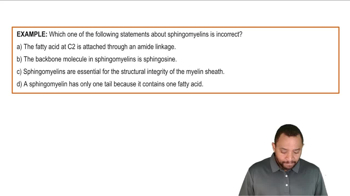
Sphingomyelins Example 2
605
views
Guided course
1:09
Sphingomyelins Example 1
569
views
Guided course
1:32
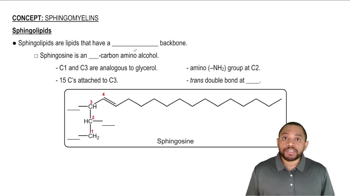
Sphingomyelins Concept 1
647
views
Terms in this set (13)
Hide definitions
Sphingolipid
A lipid class featuring a sphingosine backbone, often involved in cell membrane structure and signaling.
Sphingosine
An 18-carbon amino alcohol with a trans double bond at carbon 4, forming the backbone of certain lipids.
Amino Group
A functional group (NH2) attached at carbon 2 of sphingosine, contributing to its unique properties.
Phospholipid
A lipid type with a hydrophilic head and hydrophobic tails, essential for biological membranes.
Glycerol
A three-carbon molecule whose structure is mimicked by carbons 1 to 3 in sphingosine.
Fatty Acid
A long hydrocarbon chain attached to sphingosine via an amide bond, forming one tail of sphingomyelins.
Amide Bond
A linkage between the sphingosine backbone and fatty acid, crucial for sphingomyelin structure.
Phosphate Group
A component of the hydrophilic head in sphingomyelins, contributing to membrane polarity.
Choline
A molecule forming part of the sphingomyelin head group, enhancing hydrophilicity.
Myelin Sheath
A nerve fiber coating primarily composed of sphingomyelins, vital for proper nerve function.
Trans Double Bond
A specific unsaturation at carbon 4 in sphingosine, influencing molecular shape and function.
Hydrophilic Head
The water-attracting region of sphingomyelins, formed by phosphate and choline groups.
Hydrolyzable Lipid
A lipid type that can be broken down by water, including sphingolipids like sphingomyelins.
 BackBack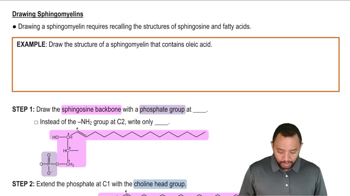
 3:11
3:11