Skip to main content
Organic Chemistry
My Course
Learn
Exam Prep
AI Tutor
Study Guides
Textbook Solutions
Flashcards
Explore
Try the app
My Course
Learn
Exam Prep
AI Tutor
Study Guides
Textbook Solutions
Flashcards
Explore
Try the app
Back
Steroids definitions
You can tap to flip the card.
Androstane
You can tap to flip the card.
👆
Androstane
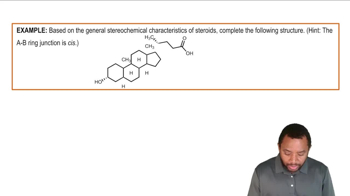
A tetracyclic hydrocarbon core with three cyclohexane rings, one cyclopentane ring, and two methyl groups at specific positions.
Track progress
Control buttons has been changed to "navigation" mode.
1/15
Related flashcards
Related practice
Recommended videos
Steroids quiz
Steroids
13 Terms
Steroids
32. Lipids
5 problems
Topic
Sphingomyelins
32. Lipids
5 problems
Topic
32. Lipids - Part 1 of 3
4 topics
12 problems
Chapter
32. Lipids - Part 2 of 3
4 topics
12 problems
Chapter
32. Lipids - Part 3 of 3
2 topics
6 problems
Chapter
Guided course
1:45
Steroids Concept 2
528
views
Guided course
1:01
Steroids Example 2
521
views
Guided course
1:54
Steroids Concept 6
504
views
Terms in this set (15)
Hide definitions
Androstane
A tetracyclic hydrocarbon core with three cyclohexane rings, one cyclopentane ring, and two methyl groups at specific positions.
Tetracyclic Core
A fused ring system consisting of four rings, forming the backbone of steroid molecules.
Cyclohexane Ring
A six-membered saturated ring, three of which are fused in the steroid skeleton.
Cyclopentane Ring
A five-membered saturated ring fused to three cyclohexane rings in steroids.
Methyl Group
A small alkyl group attached at carbons 13 and 10, designated as angular and beta in steroids.
Trans Configuration
A ring junction where substituents are on opposite sides, resulting in rigidity and resistance to ring flipping.
Cis Configuration
A ring junction where substituents are on the same side, leading to less rigidity and more flexibility.
Beta Position
An orientation where a group points up, often depicted as a wedge in steroid structures.
Alpha Position
An orientation where a group points down, typically shown as a dash in structural drawings.
Steroid Skeleton
The basic framework of steroids, composed of four fused rings and numbered carbons for functional group placement.
Steroid Hormone
A chemical messenger derived from the steroid skeleton, classified into sex and adrenocortical types.
Androgen
A male sex hormone produced in the testes, responsible for male sexual development and muscle growth.
Estrogen
A female sex hormone with an aromatic ring, produced in ovaries, and lacking a methyl group at carbon 10.
Progestin
A female sex hormone produced in ovaries, regulating the menstrual cycle and pregnancy.
Adrenocortical Hormone
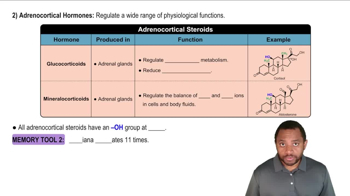
A steroid hormone from adrenal glands, regulating glucose metabolism or ion balance, with an OH group at carbon 11.
 BackBack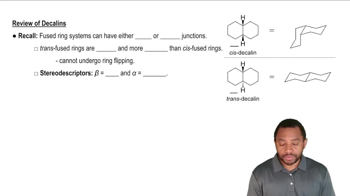
 1:45
1:45