Back

Structure Determination without Mass Spect definitions

Control buttons has been changed to "navigation" mode.
1/14
  • Structure Determination

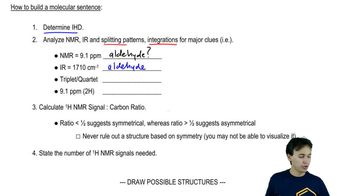
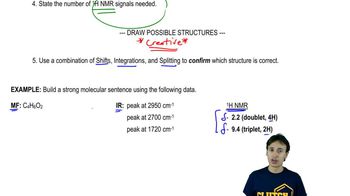
    Process of deducing a molecule's arrangement using molecular formula, NMR, and IR data before proposing possible structures.
  • Molecular Formula

    Provides the count of each atom type in a compound, serving as the foundation for deducing possible structures.
  • NMR Spectrum

    Graphical output showing chemical environments of hydrogens, offering clues via chemical shifts, splitting, and integration.
  • IR Spectrum

    Plot indicating bond vibrations, where specific peaks reveal the presence of functional groups like carbonyls or alcohols.
  • Molecular Sentence

    Strategic summary of all spectral clues and formula data, organized to guide efficient structure proposals.
  • Hydrogen Deficiency

    Calculation revealing the number of rings and multiple bonds, crucial for narrowing down possible molecular frameworks.
  • Chemical Shift

    Position on the NMR spectrum indicating the electronic environment of hydrogens, often diagnostic for certain groups.
  • Integration

    NMR measurement reflecting the number of hydrogens contributing to a signal, helping assign groups within the molecule.
  • Splitting Pattern

    NMR feature showing how many neighboring hydrogens are present, aiding in deducing connectivity.
  • Functional Group

    Specific atom arrangements like aldehydes or alcohols, identified by characteristic spectral features.
  • Symmetry

    Molecular property inferred from the ratio of NMR signals to carbons, suggesting identical environments.
  • Proton NMR Signal

    Distinct peak in the NMR spectrum, each corresponding to a unique hydrogen environment in the molecule.
  • Carbon Ratio

    Fraction of NMR signals to carbon atoms, used as a heuristic for assessing molecular symmetry.
  • Aldehyde

    Functional group identified by a chemical shift near 9–10 ppm in NMR and a strong IR peak around 1710 cm⁻¹.