Back

Structure Determination without Mass Spect quiz

Control buttons has been changed to "navigation" mode.
1/15
  • What is the first step in building a 'molecular sentence' for structure determination?

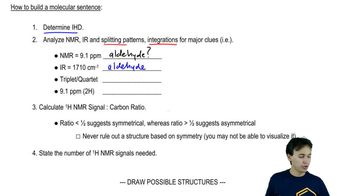
    The first step is to determine the Index of Hydrogen Deficiency (IHD), which tells you about double bonds, rings, and triple bonds in the molecule.
  • How can a chemical shift of 9.1 in proton NMR help identify a functional group?

    A chemical shift of 9.1 in proton NMR suggests the presence of an aldehyde group, as aldehyde protons typically appear in the 9-10 ppm range.
  • What IR peak would confirm the presence of an aldehyde?

    An IR peak at 1710 cm⁻¹ would confirm the presence of a carbonyl group, which is characteristic of an aldehyde.
  • How do splitting patterns in NMR provide structural clues?

    Splitting patterns, such as a triplet and a quartet, can indicate the presence of specific groups like an ethyl group attached to another group in the molecule.
  • What does the integration value in NMR tell you?

    Integration in NMR tells you the number of hydrogens contributing to a particular signal, helping to deduce the number of equivalent protons in the molecule.
  • If a 9.1 ppm NMR signal integrates to 2H, what does that suggest?

    It suggests there are two aldehyde groups in the molecule, since each aldehyde typically contributes one proton in that region.
  • What is the purpose of calculating the proton NMR signal to carbon ratio?

    This ratio helps assess the symmetry of the molecule; a low ratio suggests high symmetry, while a high ratio suggests asymmetry.
  • Why should the NMR signal to carbon ratio only be used as a guide?

    Because it is not a definitive rule and can be misleading, especially for molecules with intermediate ratios or complex symmetry.
  • When is the NMR signal to carbon ratio most helpful?

    It is most helpful at the extremes, such as very low or very high ratios, indicating strong symmetry or asymmetry, respectively.
  • Why is it important to match the number of NMR signals when proposing structures?

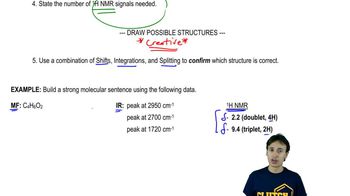
    Because only structures that yield the observed number of NMR signals are possible; drawing others wastes time and effort.
  • What should you do after gathering all spectral clues before drawing structures?

    Restate the number of proton NMR signals needed and only draw structures that could produce that number of signals.
  • How does building a 'molecular sentence' improve structure determination?

    It organizes all clues from spectra and formula into a logical summary, making the process more strategic and efficient.
  • What is the final step after proposing possible structures?

    Use a combination of chemical shifts, integrations, and splitting patterns to confirm which structure matches all the data.
  • Why is creativity still needed in structure determination, even with a systematic approach?

    Because you may need to consider a few possible structures that fit all clues, and select the correct one based on further analysis.
  • What is the main mistake students make when first attempting structure determination?

    They often start drawing random structures without organizing clues, which is inefficient and leads to wasted time.