Skip to main content
Organic Chemistry
My Course
Learn
Exam Prep
AI Tutor
Study Guides
Textbook Solutions
Flashcards
Explore
Try the app
My Course
Learn
Exam Prep
AI Tutor
Study Guides
Textbook Solutions
Flashcards
Explore
Try the app
Back
Substitution Comparison definitions
You can tap to flip the card.
SN1 Mechanism
You can tap to flip the card.
👆
SN1 Mechanism
A pathway where a carbocation intermediate forms before nucleophilic attack, favored by weak nucleophiles and stable tertiary alkyl halides.
Track progress
Control buttons has been changed to "navigation" mode.
1/14
Related flashcards
Related practice
Recommended videos
Substitution Comparison quiz
Substitution Comparison
15 Terms
Substitution Comparison
7. Substitution Reactions
7 problems
Topic
Ernest
SN1 Reaction
7. Substitution Reactions
7 problems
Topic
Ernest
7. Substitution Reactions
5 topics
15 problems
Chapter
Johnny
03:32
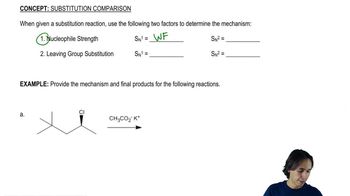
How do we predict if the mechanism is SN1 or SN2?
5149
views
43
rank
5
comments
Terms in this set (14)
Hide definitions
SN1 Mechanism
A pathway where a carbocation intermediate forms before nucleophilic attack, favored by weak nucleophiles and stable tertiary alkyl halides.
SN2 Mechanism
A concerted substitution process involving a backside attack by a strong nucleophile, best with methyl or primary alkyl halides.
Nucleophile Strength
A measure of how readily a species donates electrons to form a new bond, influencing which substitution mechanism occurs.
Leaving Group
An atom or group that departs with a pair of electrons during substitution, affecting reaction rate and pathway.
Backside Attack
A direct approach of a nucleophile opposite the leaving group, essential for the SN2 mechanism.
Carbocation
A positively charged carbon intermediate, whose stability determines the feasibility of the SN1 pathway.
Tertiary Alkyl Halide
A carbon bonded to three other carbons and a halogen, highly stable for carbocation formation in SN1 reactions.
Primary Alkyl Halide
A carbon bonded to one other carbon and a halogen, favoring SN2 reactions due to minimal steric hindrance.
Secondary Alkyl Halide
A carbon bonded to two other carbons and a halogen, showing intermediate reactivity in both SN1 and SN2 mechanisms.
Methyl Group
A single carbon attached to three hydrogens, offering the least steric hindrance and best suited for SN2 reactions.
Steric Hindrance
The crowding around a reactive center that impedes nucleophilic attack, especially relevant in SN2 reactions.
Degree of Substitution
The classification of a carbon based on the number of attached alkyl groups, influencing substitution mechanism preference.
Reaction Mechanism
A stepwise description of how reactants convert to products, crucial for predicting substitution outcomes.
Product Prediction
The process of determining the final compounds formed based on the chosen substitution pathway and reactants.
 BackBack

 03:32
03:32