Back

Sulfide Oxidation definitions

Control buttons has been changed to "navigation" mode.
1/13
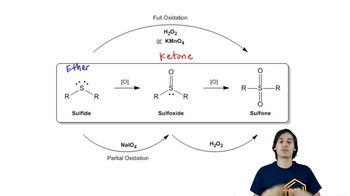
  • Sulfide

    A molecule featuring a sulfur atom bonded to two carbon groups, structurally analogous to an ether but with sulfur replacing oxygen.
  • Sulfoxide

    A compound formed by the oxidation of a sulfide, where sulfur is bonded to one oxygen and two carbon groups, resembling a ketone with sulfur.
  • Sulfone

    The most oxidized form of a sulfide, containing a sulfur atom double-bonded to two oxygens and bonded to two carbon groups, with no direct carbon analog.
  • Ether

    A molecule with an oxygen atom bonded to two carbon groups, known for its low reactivity compared to its sulfur analog.
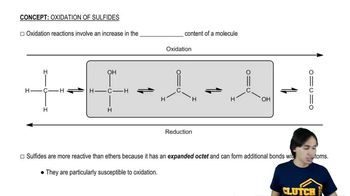
  • Oxidation

    A process involving an increase in the number of bonds to oxygen or the oxygen content within a molecule.
  • Expanded Octet

    A property of sulfur allowing it to accommodate more than eight electrons, enabling up to six bonds and increased reactivity.
  • Oxidizing Agent

    A substance capable of increasing the oxygen content of another molecule, often driving reactions to higher oxidation states.
  • Hydrogen Peroxide

    A strong oxidizing agent commonly used to convert sulfides directly to sulfones without stopping at intermediate stages.
  • Potassium Permanganate

    A powerful oxidizing agent, often abbreviated as KMnO4, that fully oxidizes sulfides to sulfones.
  • Sodium Periodate

    A selective oxidizing agent, NaIO4, used to partially oxidize sulfides to sulfoxides without further oxidation.
  • Functional Group

    A specific grouping of atoms within molecules that imparts characteristic chemical reactivity, such as sulfide, sulfoxide, or sulfone.
  • Ketone

    A compound with a carbonyl group bonded to two carbon atoms, serving as a structural analogy for sulfoxides.
  • Oxygen Content

    The total number of oxygen atoms or bonds to oxygen present in a molecule, which increases during oxidation.