Back

Tautomerization definitions

Control buttons has been changed to "navigation" mode.
1/14
  • Alpha Carbon

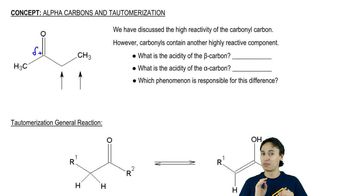
    A carbon atom directly adjacent to a carbonyl group, notable for its enhanced acidity compared to typical alkanes.
  • pKa

    A logarithmic measure of acidity; lower values indicate stronger acids, with alpha carbons showing much lower values than alkanes.
  • Tautomerization

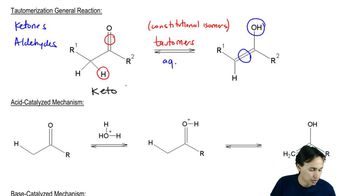
    A process where a pi bond and a hydrogen atom exchange positions, creating constitutional isomers in equilibrium.
  • Ketone

    A carbonyl-containing compound that can undergo tautomerization, forming equilibrium with its enol form.
  • Aldehyde

    A carbonyl compound capable of tautomerization, forming tautomers with distinct structural features.
  • Constitutional Isomer

    Molecules with the same formula but different connectivity, as seen in tautomers formed during tautomerization.
  • Keto Tautomer

    The form of a tautomer that retains the original carbonyl structure, predominant in equilibrium with enol.
  • Enol Tautomer

    A tautomer featuring a hydroxyl group bonded to a double-bonded carbon, also known as a vinyl alcohol.
  • Vinyl Alcohol

    A structure with a hydroxyl group directly attached to a carbon-carbon double bond, characteristic of the enol tautomer.
  • Acid Catalysis

    A mechanism where protonation of the carbonyl initiates tautomerization, leading to the formation of enol.
  • Base Catalysis

    A mechanism where deprotonation of the alpha proton triggers tautomerization, often forming an enolate intermediate.
  • Enolate Ion

    A negatively charged intermediate formed during base-catalyzed tautomerization, highly reactive in organic reactions.
  • Conjugate Base

    The species formed after an acid donates a proton, stabilized in alpha carbons due to tautomerization.
  • Equilibrium

    A dynamic state where keto and enol tautomers interconvert, maintaining constant proportions in solution.