Back

Heck Reaction definitions

Control buttons has been changed to "navigation" mode.
1/15
  • Heck Reaction

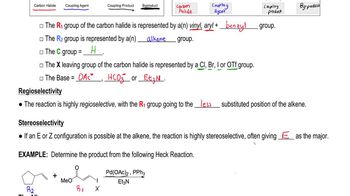
    Coupling process joining a carbon halide and an alkene using a palladium catalyst to yield a more substituted alkene.
  • Carbon Halide

    Organic molecule containing a carbon atom bonded to a halogen, serving as a key reactant in cross-coupling.
  • Alkene

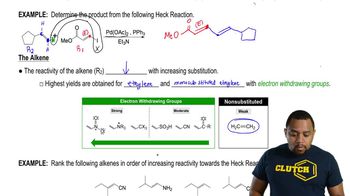
    Unsaturated hydrocarbon with a carbon-carbon double bond, acting as the coupling partner in this reaction.
  • Palladium Catalyst

    Transition metal complex facilitating bond formation and regeneration during the catalytic cycle.
  • Regioselectivity

    Preference for the new group to attach at the less substituted position of the alkene during product formation.
  • Stereoselectivity

    Tendency to form E-configured alkenes when geometric isomers are possible in the product.
  • Oxidative Addition

    Step where the carbon halide binds to palladium, increasing its oxidation state and forming a new complex.
  • Syn Addition

    Simultaneous addition of two groups to the same side of an alkene's pi bond, unique to this mechanism.
  • Reductive Elimination

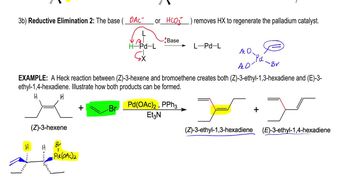
    Process forming the final alkene product and regenerating the palladium catalyst for another cycle.
  • Leaving Group

    Atom or group, such as halide or triflate, that departs with electron pair during bond formation.
  • Electron-Withdrawing Group

    Substituent that pulls electron density away from the alkene, enhancing its reactivity in the reaction.
  • Acetate Ion

    Common base used to remove hydrogen during catalyst regeneration, denoted as OAc.
  • Transition Metal Complex

    Molecular entity containing a central metal atom, such as palladium, surrounded by ligands.
  • Catalytic Cycle

    Sequence of recurring mechanistic steps that regenerate the catalyst and produce the desired product.
  • 18 Electron Rule

    Stability guideline for transition metal complexes, favoring configurations with 18 valence electrons.