Back

Thermal Cycloaddition Reactions quiz

Control buttons has been changed to "navigation" mode.
1/15
  • What type of reaction is a thermal cycloaddition and how many pi bonds are destroyed in the process?

    A thermal cycloaddition is a pericyclic reaction where two pi bonds are destroyed during a heat-activated cyclic mechanism.
  • What is a well-known example of a thermal cycloaddition reaction?

    The Diels-Alder reaction is a well-known example of a thermal cycloaddition.
  • What is the general outcome of a thermal cycloaddition in terms of pi bonds and ring formation?

    Three pi bonds react under heat to form a new cyclic product with only one pi bond.
  • What theory helps explain the driving force behind cycloaddition reactions?

    Frontier Molecular Orbital Theory explains the driving force behind cycloaddition reactions.
  • In a cycloaddition, which molecular orbitals interact to form new bonds?

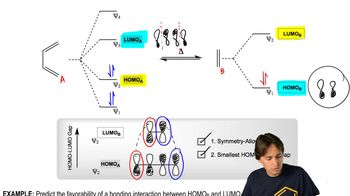
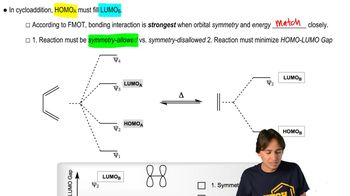
    The Highest Occupied Molecular Orbital (HOMO) of one molecule interacts with the Lowest Unoccupied Molecular Orbital (LUMO) of another molecule.
  • What two main factors determine if a cycloaddition reaction will occur?

    The reaction must be symmetry allowed and the HOMO-LUMO energy gap should be minimized.
  • What does 'symmetry allowed' mean in the context of cycloaddition reactions?

    'Symmetry allowed' means that the terminal lobes of the interacting orbitals have matching phases, allowing strong bonding overlap.
  • Why is minimizing the HOMO-LUMO energy gap important in cycloadditions?

    A smaller HOMO-LUMO gap allows for stronger bonding interactions and makes the reaction more favorable.
  • How many pi electrons does a typical diene have, and how are its molecular orbitals filled?

    A typical diene has 4 pi electrons, which fill the lowest two molecular orbitals.
  • What role does heat play in thermal cycloaddition reactions?

    Heat provides the energy needed for electrons in the HOMO to jump into the LUMO of another molecule.
  • How can you determine if a cycloaddition is symmetry allowed using molecular orbitals?

    By drawing the molecular orbitals and checking if the terminal lobes of the HOMO and LUMO have the same phase for overlap.
  • What happens if the terminal lobes of the interacting orbitals do not match in phase?

    If the terminal lobes do not match in phase, the reaction is symmetry forbidden and a new single bond cannot form.
  • Is it possible for the HOMO of the alkene to interact with the LUMO of the diene in a cycloaddition?

    Yes, it is possible, but the preferred pathway is the one with the smallest HOMO-LUMO energy gap.
  • Why might the orientation of HOMO and LUMO be drawn differently in textbooks compared to the video?

    Textbooks often draw HOMO on top and LUMO on the bottom to better illustrate stereochemistry, but the orientation does not affect the theoretical outcome.
  • What is the main reason the Diels-Alder reaction is symmetry allowed under thermal conditions?

    The main reason is that the terminal lobes of the diene's HOMO and the alkene's LUMO match in phase, allowing strong orbital overlap.