Back

Wave Function quiz

Control buttons has been changed to "navigation" mode.
1/15
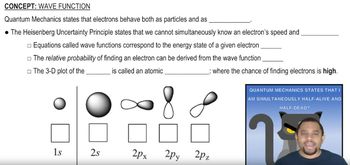
  • What principle states that we cannot simultaneously know both the speed and position of an electron?

    The Heisenberg uncertainty principle states that we cannot simultaneously know both the speed and position of an electron.
  • What does the wave function (ψ) represent in quantum mechanics?

    The wave function (ψ) represents the energy state of an electron.
  • How do we determine the relative probability of finding an electron using the wave function?

    We determine the relative probability by squaring the wave function (ψ^2).
  • What is an atomic orbital in terms of wave functions?

    An atomic orbital is a 3D plot of the squared wave function (ψ^2), representing the probable location of electrons.
  • What is the shape of an s orbital?

    An s orbital is spherical in shape.
  • How are p orbitals commonly described in terms of their shape?

    P orbitals are described as dumbbell-shaped or resembling peanuts.
  • What is the electron configuration for carbon (atomic number 6)?

    The electron configuration for carbon is 1s2, 2s2, 2p2.
  • According to the Pauli exclusion principle, how must electrons be arranged in an orbital?

    Electrons in an orbital must have opposite spins.
  • What rule states that electrons fill orbitals singly before pairing up?

    Hund's rule states that electrons fill orbitals singly before pairing up.
  • What is the maximum number of electrons that can be housed in the first shell of an atom?

    The first shell can house a maximum of 2 electrons.
  • What is the maximum number of electrons possible in the second shell of an atom?

    The second shell can hold up to 8 electrons.
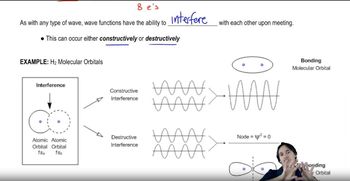
  • What is constructive interference in the context of wave functions?

    Constructive interference occurs when waves overlap and amplify each other, increasing the probability of finding electrons in that region.
  • What is destructive interference in the context of wave functions?

    Destructive interference occurs when waves overlap and cancel each other out, decreasing the probability of finding electrons in that region.
  • What is a bonding molecular orbital?

    A bonding molecular orbital is a region where constructive interference increases the likelihood of finding electrons, forming a chemical bond.
  • What is a node in quantum mechanics?

    A node is an area where the probability of finding an electron is zero.