Back

Williamson Ether Synthesis definitions

Control buttons has been changed to "navigation" mode.
1/13
  • Ether

    A functional group featuring an oxygen atom bonded to two alkyl or aryl groups, often formed as the main product in certain organic reactions.
  • Williamson Ether Synthesis

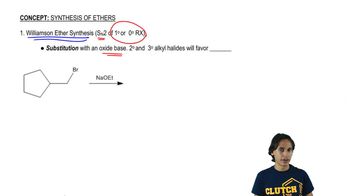
    A method for preparing ethers by reacting a primary or methyl alkyl halide with an oxide base via an SN2 mechanism.
  • SN2 Reaction

    A bimolecular nucleophilic substitution mechanism involving a single concerted step with a backside attack, leading to inversion of configuration.
  • Alkyl Halide

    An organic molecule containing a halogen atom attached to an alkyl group, serving as a key reactant in ether formation.
  • Primary Alkyl Halide

    A halide where the carbon bonded to the halogen is attached to only one other carbon, making it highly reactive in SN2 processes.
  • Methyl Alkyl Halide

    A halide where the halogen is attached to a methyl group, offering minimal steric hindrance for nucleophilic attack.
  • Oxide Base

    A negatively charged oxygen-containing species, such as an alkoxide, acting as a nucleophile in ether synthesis.
  • Steric Hindrance

    A spatial restriction caused by bulky groups around a reactive site, often preventing certain reactions like SN2.
  • E2 Reaction

    A bimolecular elimination mechanism favored by secondary or tertiary alkyl halides due to steric hindrance.
  • Nucleophile

    A species with a negative charge or lone pair, capable of donating electrons to form a new chemical bond.
  • Leaving Group

    An atom or group that departs with a pair of electrons during a substitution or elimination reaction.
  • Backside Attack

    A hallmark of SN2 reactions where the nucleophile approaches the substrate from the side opposite the leaving group.
  • Flowchart

    A decision-making tool used to determine the appropriate reaction mechanism based on reactant properties.