Skip to main content
Organic Chemistry
My Course
Learn
Exam Prep
AI Tutor
Study Guides
Textbook Solutions
Flashcards
Explore
Try the app
My Course
Learn
Exam Prep
AI Tutor
Study Guides
Textbook Solutions
Flashcards
Explore
Try the app
Back
Zaitsev Rule definitions
You can tap to flip the card.
Elimination Reaction
You can tap to flip the card.
👆
Elimination Reaction
A process where atoms are removed from a molecule, often forming multiple possible alkene products.
Track progress
Control buttons has been changed to "navigation" mode.
1/15
Related flashcards
Related practice
Recommended videos
Zaitsev Rule quiz #1
Elimination and Zaitsev's Rule
10 Terms
Zaitsev Rule
9. Alkenes and Alkynes
7 problems
Topic
Johnny
Dehydrohalogenation
9. Alkenes and Alkynes
2 problems
Topic
Johnny
9. Alkenes and Alkynes - Part 1 of 2
5 topics
11 problems
Chapter
Ernest
9. Alkenes and Alkynes - Part 2 of 2
5 topics
11 problems
Chapter
Johnny
02:39
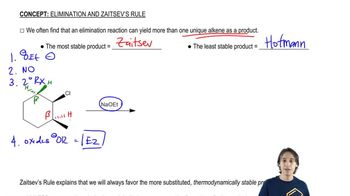
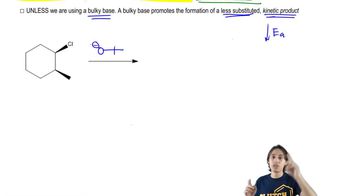
Hofmann product
3567
views
25
rank
13
comments
01:18
Defining Zaitsev’s Rule
4809
views
38
rank
2
comments
07:01
Zaitsev product
4243
views
42
rank
36
comments
Terms in this set (15)
Hide definitions
Elimination Reaction
A process where atoms are removed from a molecule, often forming multiple possible alkene products.
Zaitsev Rule
A guideline predicting that the most substituted alkene forms as the major product in elimination reactions.
Zaitsev Product
The most stable alkene formed, characterized by having the greatest number of R groups around the double bond.
Hofmann Product
The less stable alkene formed, identified by having fewer R groups around the double bond.
R Group
A generic substituent or side chain attached to a molecule, influencing alkene stability in elimination.
Thermodynamic Control
A condition where the most stable product is favored due to its lowest free energy at equilibrium.
Kinetic Control
A scenario where the product formed fastest, with the lowest activation energy, predominates.
Activation Energy
The energy barrier that must be overcome for a reaction to proceed from reactants to products.
Energy Diagram
A graphical representation showing energy changes during a reaction, highlighting activation energy and product stability.
Transition State
A high-energy, unstable arrangement of atoms occurring during the conversion from reactants to products.
Alkene
A hydrocarbon containing a carbon-carbon double bond, often the product of elimination reactions.
Delta G
A symbol representing the change in free energy, used to compare product stabilities in reactions.
Major Product
The compound formed in the greatest amount during a reaction, often predicted by Zaitsev's rule.
Minor Product
The compound formed in lesser quantity during a reaction, typically less stable than the major product.
Concerted Reaction
A process where bond breaking and forming occur simultaneously, as seen in E2 eliminations.
 BackBack

 02:39
02:39