Organic Chemistry
My Course
Learn
Exam Prep
AI Tutor
Study Guides
Textbook Solutions
Flashcards
Explore
Try the app
My Course
Learn
Exam Prep
AI Tutor
Study Guides
Textbook Solutions
Flashcards
Explore
Try the app
Back
Ziegler-Natta Polymerization definitions
You can tap to flip the card.
Ziegler-Natta Polymerization
You can tap to flip the card.
👆
Ziegler-Natta Polymerization
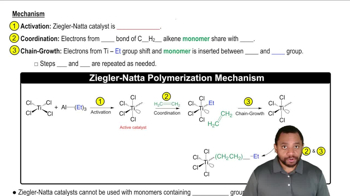
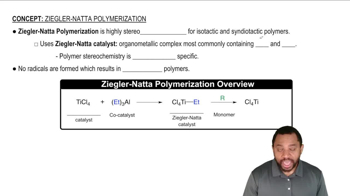
A chain-growth process using organometallic catalysts to produce polymers with controlled stereochemistry and linearity.
Track progress
Control buttons has been changed to "navigation" mode.
1/15
Related flashcards
Recommended videos
Ziegler-Natta Polymerization quiz
Ziegler-Natta Polymerization
15 Terms
1:55
Ziegler-Natta Polymerization Concept 2
577
views
1:03
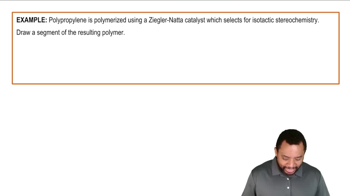
Ziegler-Natta Polymerization Example 1
578
views
1:35
Ziegler-Natta Polymerization Concept 1
618
views
Terms in this set (15)
Hide definitions
Ziegler-Natta Polymerization
A chain-growth process using organometallic catalysts to produce polymers with controlled stereochemistry and linearity.
Organometallic Catalyst
A complex containing metal and organic groups, crucial for initiating and controlling polymer growth and stereochemistry.
Titanium Tetrachloride
A titanium compound serving as the inactive catalyst precursor, activated by reaction with an aluminum compound.
Triethylaluminum
An aluminum compound with three ethyl groups, acting as a cocatalyst to activate titanium-based catalysts.
Isotactic Polymer
A polymer with all substituents on the same side of the chain, resulting from precise stereochemical control.
Syndiotactic Polymer
A polymer with alternating substituent positions, reflecting the catalyst's ability to control stereochemistry.
Stereochemistry
The spatial arrangement of atoms in polymers, determined by catalyst specificity during polymerization.
Active Site
The region on the catalyst where monomer coordination and chain growth occur, dictating polymer structure.
Chain-Growth Polymerization
A mechanism where monomers add sequentially to a growing chain, avoiding branching and radicals.
Coordination
The interaction where a monomer's pi electrons share with the catalyst, initiating polymer chain formation.
Linear Polymer
A polymer structure without branching, resulting from the absence of free radicals in the process.
Catalyst Activation
The process where titanium and aluminum compounds interact, enabling the catalyst to initiate polymerization.
Polar Group
A functional group that, if present in a monomer, deactivates the catalyst and prevents polymerization.
Stereoselectivity
The catalyst-driven preference for forming polymers with a specific spatial arrangement of substituents.
Addition Polymer
A polymer formed by successive addition of monomers without loss of atoms, characteristic of this process.